
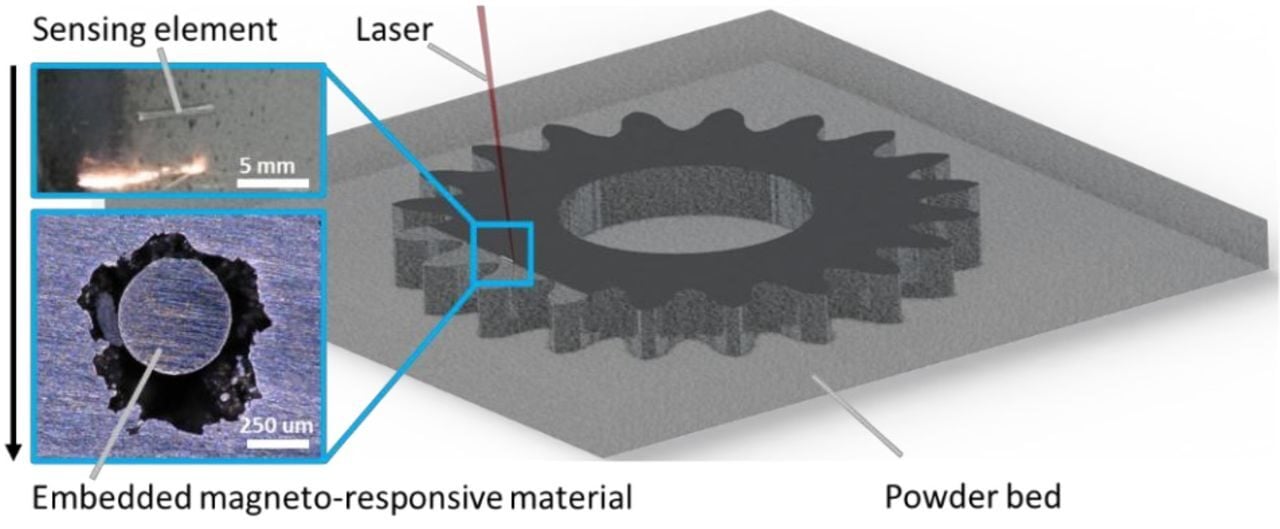
New research proposes wireless, embedded sensing for 3D printed metal parts using magnetoelastic and thermomagnetic inclusions.
Structural health monitoring has long been a headache for metal additive manufacturing, especially when engineers want to measure strain, temperature, or fatigue without adding wires and holes that compromise the part. Traditional gauges, fiber optics and acoustic emission systems either need physical access or post-build assembly, which increases touch time and risk. The new approach uses the print itself to carry passive sensors, making the part both structure and instrument.
The paper describes inclusions placed within metal parts that change their magnetic response when strained or heated. Magnetoelastic materials alter permeability under stress, while thermomagnetic materials shift magnetization with temperature, often sharply near a Curie point. If those inclusions can be read from outside the component, designers get a built-in, wireless indicator of local loads, heat and even crack initiation and growth.
Although the researchers do not publish a full manufacturing recipe in the abstract, Laser Powder Bed Fusion (LPBF) is the most likely route for such integration, given its fine feature control and common use for aerospace and medical alloys. Inclusions could be co-printed via controlled powder changes, or inserted as preforms during a paused build — both methods seen previously in embedded-electronics experiments.
How The Inclusions Likely Work
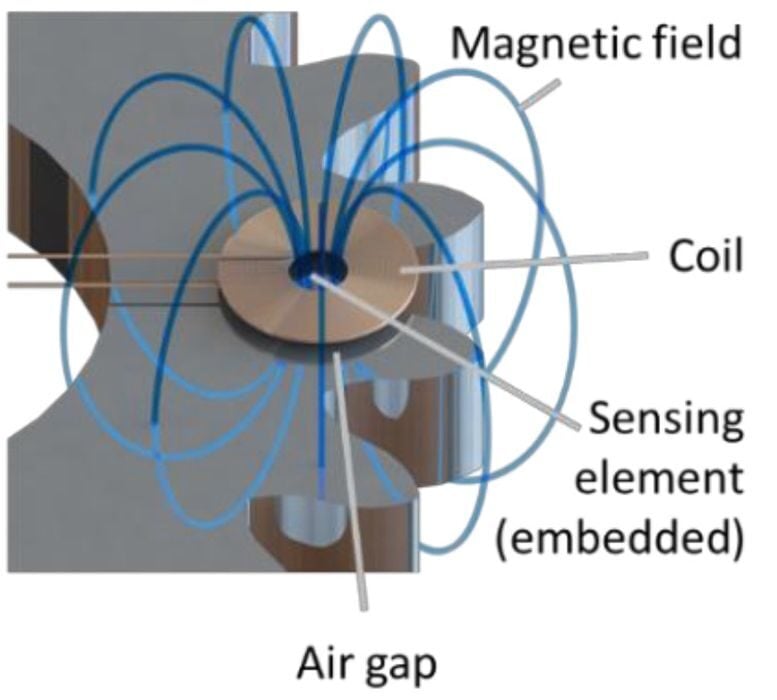
The mechanism is conceptually simple: excite the part with an external magnetic field and measure the response. A small coil or probe induces a field; the inclusion’s magnetoelastic state modulates the local permeability and magnetic losses; the probe measures the amplitude and phase shift. Thermomagnetic inclusions act as temperature tags whose magnetic signature varies with heat, enabling non-contact thermometry.
Crack growth sensing comes from geometry. If an inclusion crosses a high-stress path, a propagating crack that severs or distorts it will cause a distinct change in the magnetic response. In effect, the inclusion becomes an embedded, breakable loop or resonant element whose signature tells you not only that damage occurred, but approximately where.
The interesting part for AM is what this could change in operations. Passive tags mean no wires to route, no epoxy bonds to age, and no post-assembly metrology fixtures inside tight build envelopes. Service bureaus could deliver parts with built-in calibration features; automotive and aerospace teams could track fatigue without redesigning housings for connectors. Because the readout is wireless, it aligns with predictive maintenance workflows that already use eddy current and magnetic particle inspection.
Real Constraints To Solve
Important details remain unknown: the paper’s abstract does not list material systems, read range, sensitivity or spatial resolution. Magnetic penetration in dense metals, especially ferromagnetic steels, can limit sensing depth and complicate calibration. Heat treatment and Hot Isostatic Pressing could alter magnetic domains, so post-processing recipes may need adaptation to preserve sensor function.
Multi-material LPBF also carries practical hurdles: powder cross-contamination, gas handling, parameter sets for dissimilar alloys, and quality assurance across interfaces. If the method relies on insert placement, placement accuracy, metallurgical bonding and porosity at the interface must be addressed. Electromagnetic noise on the factory floor and repeatable probe positioning will influence reliability just as much as the inclusion design.
Economically, the upside is reduced touch time and an upgraded digital thread — parts can ship with embedded health data hooks. The downside is process complexity and potential certification friction, since embedded foreign phases in critical hardware trigger new validation requirements. Without hard numbers on strain resolution, temperature range, cycles to failure, and interrogation speed, the impact on throughput and maintenance intervals remains speculative.
What should readers watch for next? Look for benchmarks like microstrain sensitivity, temperature accuracy across typical AM operating ranges, and demonstrated detection of sub-millimeter crack growth under cyclic loading. Pilot parts in aluminum or titanium alloys would suggest manufacturability; surviving heat treatments would indicate robustness. Integration with existing non-destructive evaluation tools and clear guidelines on inclusion placement would move this from lab curiosity to shop-floor option.
If magnetoelastic and thermomagnetic inclusions pan out, 3D printed metal parts might finally graduate from silent components to self-reporting colleagues — and that could change how we design for fatigue.
Via arXiv
