Subscribe


Subscribe by Email. Enter address:

Search

Powered by Squarespace
Sponsors

Recommended
  • Fabricated: The New World of 3D Printing
    Fabricated: The New World of 3D Printing
    by Hod Lipson, Melba Kurman
  • Getting Started with MakerBot
    Getting Started with MakerBot
    by Bre Pettis, Anna Kaziunas France, Jay Shergill
  • Bend, Not Break
    Bend, Not Break
    Portfolio
  • Makers: The New Industrial Revolution
    Makers: The New Industrial Revolution
    by Chris Anderson
  • Makers
    Makers
    by Cory Doctorow
  • 3Dconnexion SpaceNavigator SE (Standard Edition) 3D Navigation Device USB ( 3DX-700028 )
    3Dconnexion SpaceNavigator SE (Standard Edition) 3D Navigation Device USB ( 3DX-700028 )
    3D Connexion
  • Printing in Plastic: Build Your Own 3D Printer (Technology in Action)
    Printing in Plastic: Build Your Own 3D Printer (Technology in Action)
    by James Floyd Kelly, Patrick Hood-Daniel
  • The Homebrew Industrial Revolution: A Low-Overhead Manifesto
    The Homebrew Industrial Revolution: A Low-Overhead Manifesto
    by Kevin A. Carson

Entries in video (53)

Saturday
Apr132013

Stratasys's Finishing Secrets

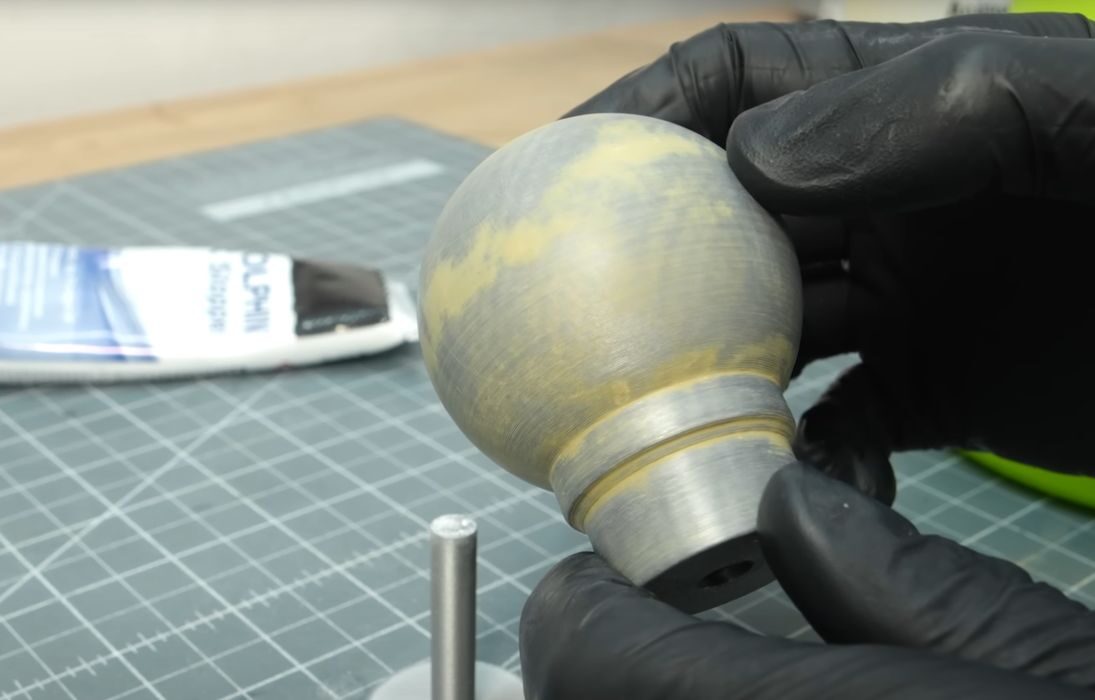
Stratasys has released a video detailing some of their secret (well, maybe not so secret) finishing processes. The video shows various tumbling media machines that operate similar to rock polishing tumblers - an object is tossed around within a bath of rough media. Gradually the objects become smooth after a relatively short period in the tumbler. 
 
What's interesting for home 3D printer operators is the explanation of the different types of tumbling media used at Stratasys. Through extensive experimentation Stratasys has determined the best type of media for different 3D printed plastics. 
 
This approach could easily be replicated by hobbyists using much smaller tumblers, if similar tumbling media could be obtained. We took a quick look and found sources for said media, but the minimum order was 800 pounds. Anyone need any? 
 
Friday
Apr122013

3D Printed Steadicam

Have an idle 3D printer and a GoPro action cam? Why not build yourself your very own GoPro steadicam mount? An Instructables by member haqnmaq shows you all the necessary steps, including 3D printing several parts for the key mechanism. 
 
The Instructable includes the STL 3D models for the Fork and Gimbal pieces, which you can easily print. All other required parts are simply common screws, bolts, nuts, washers, a threaded rod, a shoelace and the handle from a paint roller. Easy! 
 
Your 3D printer is designed to make stuff - for you. Make it so!
 
Thursday
Mar142013

3D Printing Basics Explained

Fabbaloo's own General Fabb appears in a video produced by the Winnipeg Free Press. In the video our General introduces the concept of 3D printing in a minute or two for those who haven't been exposed to the technology. 
 
The video takes place at Canada's largest makerspace, AssentWorks, another venture by the General. The 9,000sf makerspace is equipped with nearly USD$700,000 of advanced equipment, including several 3D printers that appear in the video. 
 
Thursday
Mar072013

PBS On 3D Printing

PBS has produced a brief seven minute video providing an overview of 3D printing, including interviews with Solidoodle, Shapeways and Wired. 
 
They cover the possibilities of the technology, whether for good or evil and generally get you wound up about the future. Exciting! 
 
Monday
Feb252013

Prehistoric 3D Printing Video

And now some 3D Printing history. This amazing historic TV clip originates with a show entitled, "Good Morning America" and is dated from 1989 - twenty-four years ago. 
 
It's so ancient they don't even refer to the process as "3D Printing", but use "Stereolithography", the name of the process just then invented by Chuck Hull, who is also interviewed in the piece. Who's Chuck Hull, you ask? He's the founder of 3D Systems. That Chuck Hull. 
 
The piece also features an early Apple Computer (as it was then known) using stereolithography to help design a modem case shown here. 
 
Finally we can confirm that this video was actually taken in the 1980s by this screen cap of GMA then-host, the very beautiful Joan Lunden. Definitely 1980s. She says, ominously: 
 
Boy, it will be really interesting to see how scientists take this now and apply it in the future. 
 
Welcome to The Future
 
Tuesday
Feb052013

Global TV Features 3D Printing

Chief Correspondent Carolyn Jarvis of Canada's Global TV presented a very comprehensive look at today's state of 3D printing on their current affairs show, "16x9". We bring this to your attention as this is perhaps the most mature examination of the technology we've recently seen by the media, which recently has tended towards the spectacular, outrageous and outright incorrectness. Not so in this video. 
 
In the 13 minute video, Jarvis not only explains how the technology works, but visits several key figures in today's 3D printing industry. 
 
Dr. Anthony Atala of the Wake Forest Institute for Regenerative Technology explains the current state of bio-printing, with a focus on printing human organs. 
 
Cornell's Dr. Hod Lipson explains some of the more unusual uses of 3D printing that have developed since the advent of industrial prototypes some twenty years ago. 
 
Bre Pettis, CEO of MakerBot, explains the process of public education his company has undertaken by opening a retail store in New York City for the public to view 3D printers and 3D printed objects. 
 
Cody Wilson, spokesman for Defense Distributed, and also named one of the most dangerous people in 3D printing, explains his view on 3D printed weaponry. Wilson also demonstrates printing the critical lower receiver piece of the AR-15 rifle and even fires it on camera. It lasts for eleven rounds before failing. 
 
The video also includes clips of many amazing 3D printed feats, such as the Urbee 3D printed car, chocolate printing and printing unborn children. 
 
Monday
Jan142013

The Form 1, Live

At CES we spent some quality time with Formlabs Co-Founder Maxim Lobovsky. After we sorted out the bizarre food ordering procedure at a funky Japanese burger food truck, we talked about Formlab's experience so far. 
 
As a startup company, they're heavily concerned with focusing on delivering a quality product. Lobovsky says, "Everyone has ideas on what we should be doing", but their challenge is to work on only the critical elements to achieve success. They've kept the design of the Form 1 as simple as possible for the initial release, leaving more complex improvements until later. 
 
Lobovsky could not tell us how many units have been ordered beyond their spectacular Kickstarter campaign, which sold an amazing 1,028 machines. However, we got the impression it was "lots". 
 
Back inside the show, Lobovsky managed to give us a personal tour through the Form 1, demonstrating the simplicity of its operation.
 
The Form 1 is not yet shipping until May, but Lobovsky says they have a US-based manufacturing operation that can do the job. Meanwhile, they are still accepting orders if you'd like to own one of these USD$3,299 machines. 
 
Monday
Jan072013

Augmented 3D Printing

Architects have long used 3D printing as a means to better visualize their design ideas. By 3D printing a building you can "see" it much better than through a 2D screen and thus gain insight you'd otherwise miss. 
 
But the problem is that the 3D model is, well, static. It just sits there. It may even be mono-colored. Dull. How can you visualize any dynamic activity around the design? How will the sun fall on the structure during various times of the year, for example? 
 
Now a new approach has been developed by Inition, according to a detailed report on Dezeen. The 3D company developed a custom iPad application that uses the camera to image an existing printed 3D model and overlay that with various information in an augmented reality way. 
 
It's a little hard to explain in words, so we strongly recommend you watch their video, showing, for example, moving traffic around a building, growing trees, projected wind flows, highlighted building sections and more. There's much more detail in the Dezeen article, too. 
 
There's an infinite amount of information that could be displayed in this manner. While they didn't show it, one could imagine showing intra-building pedestrian flows, evacuation simulations, snow drift projections, flooding, seasonal sunlight angles, effects of different shrubberies, and so on. 
 
We think this is an incredible development that may spawn an opportunity for new 3D businesses. 
 
Via Dezeen and Vimeo