
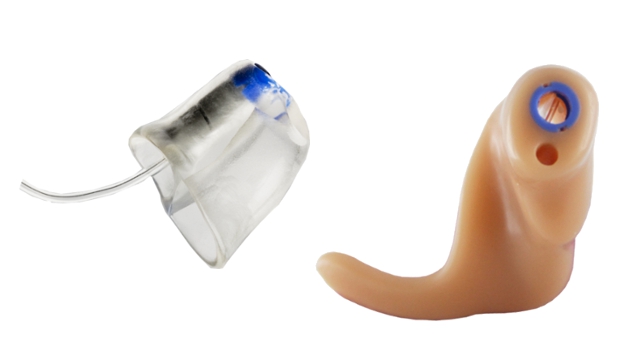
![[Image: Surdifuse-L'Embout Français]](https://fabbaloo.com/wp-content/uploads/2020/05/laser_accueil_metier_img_5eb09f79115c4.jpg)
Prodways Group says it has just become the French leader in customized ear tips for hearing aids.
The company has seen strong success with its acquisition strategy, and its latest announcement looks to build up Prodways’ portfolio on the medical side.
While “serial production” was a major theme in 3D printing for 2018, many overlook the fact that mass manufacturing is already a reality. The hearing aid industry is so well-suited to the benefits of 3D printing, notably including the ability to mass customize, that in the US adoption took just 500 days for 90% of production to include 3D printing.
In France, hearing aid production has seen acquisitions strengthen access to advanced production technologies. Surdifuse and l’Embout Français merged in December 2017, becoming major player Surdifuse-L’Embout Français.
“By 2018, this Group is expected to produce 150,000 hearing aids – excluding hearing protection, the Group’s other know-how – including more than 40% in 3D modeling. The workforce is approximately 40 people spread over the Paris and Lyon sites,” that merger announcement stated. “Through this transaction, the Group has become the French leader in the tailor-made adapter market for hearing aids, and one of the leading Europeans.”
Now Prodways has announced the acquisition of Surdifuse-L’Embout Français.
In September 2017, Prodways acquired a 75% stake in Interson-Protac, which at the time used 3D printing in about 20% of its production of ear tips. Access to Prodways’ industrial 3D printing equipment allowed for expansion of this technology in operations — just what the company is now hoping for the operations of Surdifuse-L’Embout Français.
Half of Surdifuse-L’Embout Français’ production process for its customized ear tips currently uses 3D printing. With the new structure, including a merge with Interson-Protac’s operations, Prodways expects to see an acceleration of new 3D printed products brought to market as the teams come together to strengthen hearing aid production in France and more broadly in Europe.
The cash acquisition of 100% of the share capital of Surdifuse and l’Embout Français closed yesterday and is expected to add more than €3 million in revenue to Prodways’ 2019 results. In 2017, the company saw €34.8 million in revenue; with acquisitions in late 2017 and in 2018 already paying off in reported results, numbers should continue to climb.
Specific benefit will come into Prodways’ Products division — which in October reported a 40.3% rise for the first nine months of 2018 compared to the same period in 2017. That percentage represents about a €5.1 million growth, so the additional €3M is significant for the division.
“Customized ear tips manufacturing techniques are evolving with the acceleration of digital processing and 3D printing,” Prodways Group notes. “This transaction forms part of the vertical integration strategy led by Prodways Group and strengthens the medical sector, which is a major growth driver in the Products division.”
Medical 3D printing will continue to offer opportunity — not just for the businesses capitalizing on successful adoption, but for those wearing customized devices tailor-made to fit their bodies.
Via Prodways Group




German RepRap, a maker of large-format 3D printers and silicone 3D printers, has been acquired by a surprising other party.