
A new MIT study suggests robot assembled voxels may be better than 3DCP for sustainability.
The comparison is interesting because construction 3D printing has, for years, been considered the obvious path toward automated building. Extrude concrete, stack layers, print walls, reduce labor. That’s where the industry has been going.
But this paper argues that this may not be the best approach.
The researchers instead evaluated robotically assembled discrete architected lattices, or voxels, as an alternative construction method. These are not printed walls. They are repeating structural building blocks assembled into larger load bearing frames by small robots.
In other words, this is closer to automated Lego construction than concrete extrusion.
A Different Kind Of Construction Automation
The study compares several voxel systems against other approaches, including 3D printed concrete, precast modular concrete, concrete masonry units, cold formed steel framing and stick framing.
The test case they chose was deliberately simple: a one story 5m by 10m by 3m building with walls, roof, sheathing and insulation. That is quite different from the usual 3DCP comparisons that looks only at the concrete portion of the job, while the remainder must still be done with other approaches. Here, the researchers tried to bring the alternatives to a similar completion level.
Concrete 3D printing, or 3DCP, is the most obvious comparison. It is the most visible form of automated construction, and systems such as COBOD’s BOD2 have shown that large cementitious structures can be produced with gantry systems.
But there’s one issue. Printed concrete is still concrete, and sometimes a more carbon intensive version of it. The paper notes that printable mixes can require higher cement and additive content, while many commercial approaches use the in place formworks for conventional reinforced concrete with lower cement content. That can remove a lot of the material advantage: cement production generates massive amounts of CO2.
Alternatively, the voxel approach tries to solve the problem from another direction. Instead of depositing a continuous material, it assembles lightweight lattice elements into structural frames. The robot size is decoupled from the building size, because multiple small machines can crawl over the emerging structure and add new components.
The Robot And The Blocks
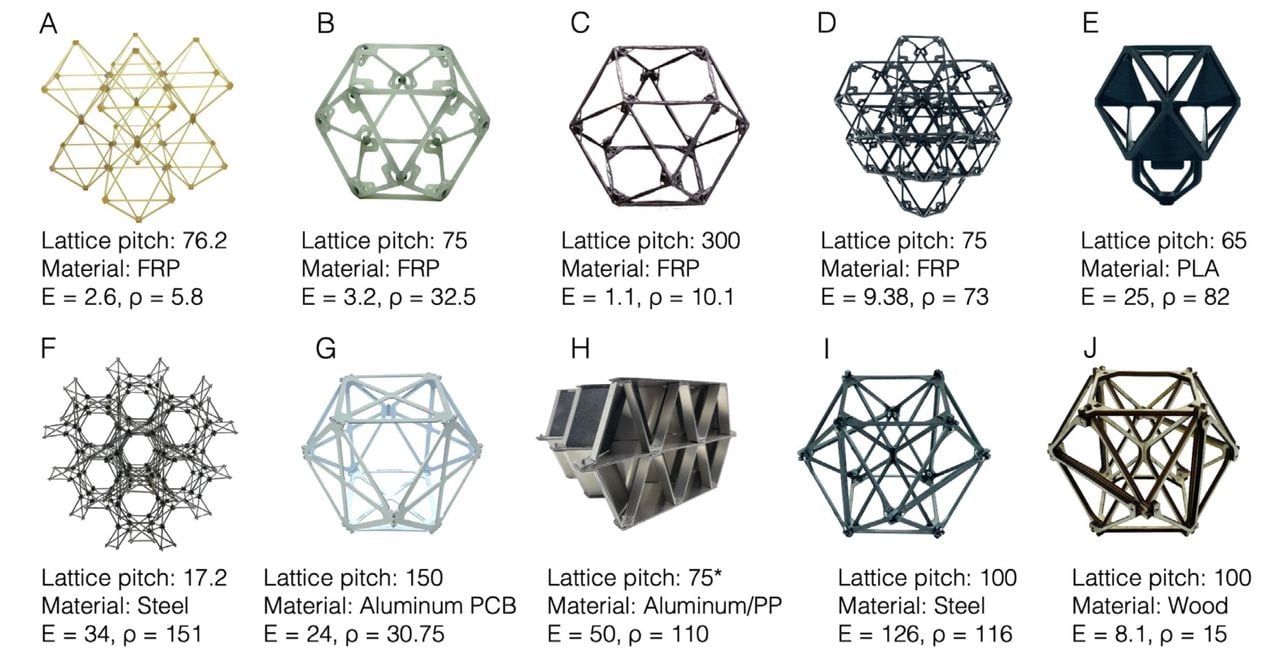
The researchers developed three new voxel types for robotic assembly: FFF printed PLA, laser cut mild steel and laser cut plywood. The PLA version is mainly a prototyping tool. The steel and plywood variants are closer to practical construction materials.
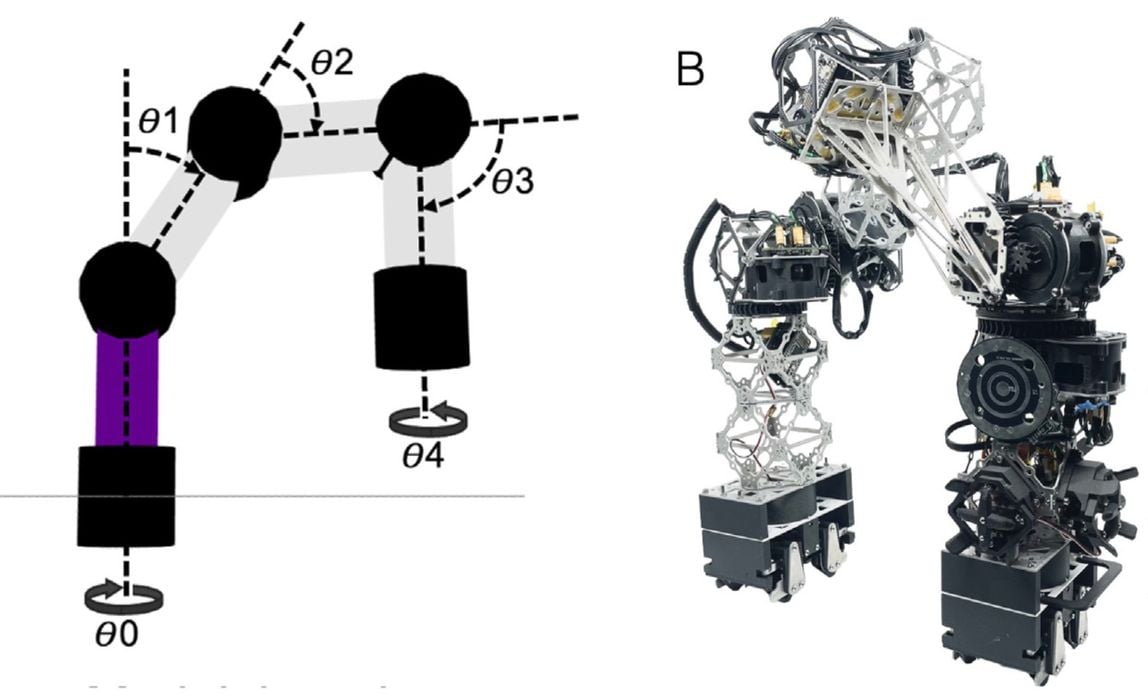
They also developed a mobile robot called MILAbot, short for Modular Inchworm Lattice Assembler robot. It is a five degree of freedom inchworm style machine that traverses a voxel lattice using grippers, carries pre compounded voxel blocks and places them into the growing structure.
That is a very different machine from a construction scale gantry printer. It is smaller, cheaper and potentially swarmable. The study estimated a future per robot cost of US$1875 after replacing 3D printed gearbox components with metal off the shelf reductions and allowing for an elevator style feed system.
This hardware design is still pretty early. For example, the current MILAbot cannot climb vertically, and the voxel feed was manual in the experiments. The authors had to extrapolate from meter scale assemblies to building scale projections.
Carbon Emissions
The strongest finding from the study is emitted CO2.
For the simplified test building, the study estimated 3D printed concrete at 17,338 kg CO2e. The steel voxel approach came in at 36% of that value, while the plywood voxel approach came in at only 17% of the 3DCP value.
That is a very large reduction. The paper summarizes the result as a potential 76% to 82% reduction in embodied carbon relative to 3D printed concrete. That doesn’t sound good for 3DCP technology.
But then, not all voxels are good voxels.
Many of the voxel systems evaluated from prior literature performed poorly on sustainability because they used high performance plastics, carbon fiber composites, aluminum or inefficient subtractive fabrication routes. The benefit was not “voxels” in general. It was specific lattice geometry, specific material choice and specific manufacturing method.
A beautifully optimized lattice made from the wrong material can still be a CO2 disaster.
This idea is compelling because it challenges a very common assumption: that construction automation must look like a giant printer. It also poses significant questions about the sustainability of 3DCP technology in general.
Maybe the future building robot is not a concrete extruder at all. Maybe it is a small assembler placing carefully designed structural bits, one voxel at a time.
Via MIT (PDF)
