
Sponsors

Recommended
  • 3Dconnexion SpaceNavigator SE (Standard Edition) 3D Navigation Device USB ( 3DX-700028 )
    3Dconnexion SpaceNavigator SE (Standard Edition) 3D Navigation Device USB ( 3DX-700028 )
    3D Connexion
  • Mastering Blender
    Mastering Blender
    by Tony Mullen
  • Kindle Wireless Reading Device (6
    Kindle Wireless Reading Device (6" Display, Global Wireless, Latest Generation)
    Amazon.com
  • Blender 3D 2.49 Incredible Machines
    Blender 3D 2.49 Incredible Machines
    by Allan Brito
  • Makers
    Makers
    by Cory Doctorow
  • 3Dconnexion SpacePilot PRO - 3D motion controller - 31 button(s) - wired - USB
    3Dconnexion SpacePilot PRO - 3D motion controller - 31 button(s) - wired - USB
    3D Connexion

Entries in medical (14)

Sunday
17Jan2010

Dental Scanning

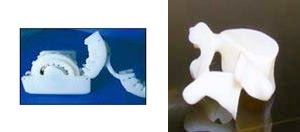
We've all been to the dentist (you have gone, haven't you?) and from time to time we need to get replacement teeth or portions thereof. The dentist makes you bite into rubber or plastic moulds to capture the 3D shape of the required parts and then sends it off for custom manufacturing. But Is there a different way to do this?  
GKS 3D Scanning has an interesting article describing their experience in this area. Here's some of their unique applications:
 
  • The "bite mould" can be laser-scanned to produce a highly accurate 3D model of the required tooth. The 3D model can then be produced on a variety of equipment using different print media. (We strongly recommend staying away from Shapeways Bronze for this application!)
  • Orthodontics can benefit from repeated laser scans that can detail the progress of tooth movement throughout the use of braces and retainers.
  • Toothbrush design can be optimized by 3D scanning many sets of teeth to produce the "average" mouth size and shape.
  • Digital storage of patient's mouth scans take up far less space in the office than the traditional plaster casts.  
  • Archival 3D casts of your teeth provide a model for future repairs when you've lost some of your teeth in a barroom dispute, or simply from nervous tooth-grinding. Just scan again and 3D print the difference. 
 
These ideas and much more can be seen at GKS's website.


Saturday
28Nov2009

Fingers Restored By 3D Scanning


Did you ever take a very close look at your fingers? They are incredibly complex machines, with not only shape and texture, but also motion. Imagine if fate caused the loss of one or more of them?

There are solutions today, such as those produced by Didrick Medical, who make a kind of finger-harness that fits over the hand and implements an "active-function artificial finger prostheses". The design permits a variety of finger loss scenarios to be resolved. This is their "X-Finger" product.

But the problem is in the build. Turns out that everyone's hands and fingers are pretty much unique. Who knew?

Didrick Medical's approach is to custom design each and every X-Finger to perfectly match the recipient. However, as you might suspect, the measurements are very complex, tedious and time consuming.

Enter 3D Laser Scanning from GKS Global Services, who used their equipment and software to gather the necessary 3D modelling data much more quickly than had been done manually. The scanning is done from a cast of the hand, presumably to avoid "twitches".

Once the 3D model is successfully captured and tweaked, SolidWorks takes over and the production process continues as normal. And the fingerless get new fingers.

Via LaserDesign

Sunday
15Nov2009

Medical 3D is Contagious


Objet's 3D printers seem to be taking hold in various medical applications, according to information passed our way. Here are four interesting approaches:


  • Biorep Technologies creates tools for diabetes researchers and has created a "Pinch Valve" for indexing fluids and avoiding contamination of equipment and fluids, as well as a silicone membrane petri dish
  • Arch Day Design creates tiny objects that interlock inside arthroscopic surgery patients to guide the microscopic tools.
  • Ivivi Technologies uses Objet tech to rapidly create prototypes for a variety of non-invasive medical applications
  • Orchid Orthopedic Solutions uses 3D tech to rapidly develop new implant applications for the orthopaedic, dental and cardiovascular markets.
Via Objet (Hat tip to Rachel)

Wednesday
09Sep2009

Biomedical Solutions Materialise


We ran across an interesting video that talks about Materialise's ventures into the medical manufacturing space. We've posted about medical uses of 3D print tech before, but Materialise specializes in this niche, and have for quite some time.

Materialise produces 3D software specifically designed for this market: Mimics, which can transform medical 2D CT or MRI data into usable 3D models. From those models prosthetics or other medical implants can be derived. In the video you'll see students using the software to design a prosthetic leg for Cassidy the dog.

How popular is this approach? According to the video, "Nearly all orthopedic implant manufacturers are using Mimics to design custom hips and knees".

Via YouTube

Friday
31Jul2009

Human Brain!

 
Admit it: you did something wrong sometime in your life and someone told you: "Get a brain!" Well, now you can!

A recent .STL upload to the Thingiverse model repository does just that. It's a 3D model of an actual human brain!

Now before you speculate on exactly *how* Jordan Miller obtained this anatomical wonder, we have to tell you that the caper was entirely legit:

This is a human brain I extracted from a public domain MRI dataset from Slicer3.4.

Commenter Zach echoes our immediate urge: "OMG. Must print!"

We're considering what other body parts might be printable from publicly available datasets? Erm. Oh, never mind...

Via Thingiverse

Monday
29Jun2009

3D-Bioplotter

 
envisionTEC produces a rather unique device called the "3D-Bioplotter". No, it does not print small mammals. Instead, it produces scaffolds.

What are scaffolds? Tissue engineering often requires a "scaffold" on which to grow living tissue, otherwise, we assume, you'd end up with misshapen blobs of living goo. The scaffolds represent the desired final shape into which tissue will be grown. The living tissue is deposited on the scaffold, and natural reproduction takes over from there. One more thing to complete the picture: the scaffolds are made from bio-degradable material. After they dissolve only the living tissue remains in the desired shape.

The 3D-Bioplotter is really a species of 3D printer that uses specific materials. It has other characteristics such as being able to work in a sterile manner, and print heads that can operate in different temperature ranges.

Via envisionTEC

Wednesday
18Mar2009

You Can Put Spares In Your Pocket!


New Scientist reports on a medical breakthrough using 3D printing: exact replicas of finger bones have been produced. Christian Weinand of Berne Switzerland has been testing a new technique in which a 3D model of a finger bone is fed into a 3D printer, and an exact duplicate is printed. By using a suitable print medium (in this case "tricalcium phosphate and a type of polylactic acid - natural structural materials found in the human body") the resulting artificial bone can be inserted into the body and take over for the failed bone. Weinand says:

In theory, you could do any bone. Now I can put spares in my pocket if I want.


You're probably wondering exactly how you get a 3D model of a bone that requires replacement. If it's being replaced, presumably it's severely damaged, or even missing. The answer is straightforward - simply scan a model from its counterpart on the opposite hand! Obviously, this approach has some limitations, as there are singularly appearing bones, and what if both sides were damaged?

Via New Scientist

Reblog this post [with Zemanta]

Friday
13Mar2009

More Metal - This Time Saving Lives!


Both ProMetal and Sintef have been working on metal printing processes, quite different from traditional plastics and powders of other 3D print processses. One of the barriers to more common use of 3D printing (aside from cost and print time) is the robustness of the printed objects. If only they could be printed in something stronger, like, say, metal?

We'll add another metal service to the list today: Arcam AB, whose tagline is "CAD TO METAL". They're not kidding:

During the CAD to Metal process, an electron beam melts metal powder in a layer-by-layer process to build the physical part. The Arcam EBM machines use a powder bed configuration and are capable of producing multiple parts in the same build


This process appears similar to that used by ProMetal, and may have been where Shapeways printed the winning design in Titanium. But there's more to the story.

Arcam has teamed up with surgeons in New Zealand to produce custom-made metal implants to replace missing or crumbling bones. 3D scanning and modeling produces a design that is then printed in titanium. The implants are then placed within the patient's body and take over the role of inadequate natural bones and bone segments.

Via Arcam, 3News, Ponoko and TreeHugger