
Subscribe


Subscribe by Email. Enter address:

Search

Powered by Squarespace
Sponsors

Recommended
  • Fabricated: The New World of 3D Printing
    Fabricated: The New World of 3D Printing
    by Hod Lipson, Melba Kurman
  • Getting Started with MakerBot
    Getting Started with MakerBot
    by Bre Pettis, Anna Kaziunas France, Jay Shergill
  • Bend, Not Break
    Bend, Not Break
    Portfolio
  • Makers: The New Industrial Revolution
    Makers: The New Industrial Revolution
    by Chris Anderson
  • Makers
    Makers
    by Cory Doctorow
  • 3Dconnexion SpaceNavigator SE (Standard Edition) 3D Navigation Device USB ( 3DX-700028 )
    3Dconnexion SpaceNavigator SE (Standard Edition) 3D Navigation Device USB ( 3DX-700028 )
    3D Connexion
  • Printing in Plastic: Build Your Own 3D Printer (Technology in Action)
    Printing in Plastic: Build Your Own 3D Printer (Technology in Action)
    by James Floyd Kelly, Patrick Hood-Daniel
  • The Homebrew Industrial Revolution: A Low-Overhead Manifesto
    The Homebrew Industrial Revolution: A Low-Overhead Manifesto
    by Kevin A. Carson

Entries in material (43)

Tuesday
Jun042013

A Resin for 3D Printed Microelectronics

Researchers at the Tokyo Institute of Technology and C-MET have developed a specialized resin that is suitable for 3D printing electronics at a microscopic scale. 
 
The goal was to develop a material usable to create micro-sized electrodes. Apparently a "carbonization" stage is required to create electrical conductivity, but current materials could not withstand that process. Deformation during carbonization defeated the builds. 
 
The new material is able to withstand carbonization and is also available as a liquid resin. This means conventional resin-based 3D printing approaches could print this material. The researchers tested this with an ultraviolet light curable print and a laser curing process. Both appear to work. 
 
This development could open up many new applications for 3D printing. For example, the researchers suggest building very small coils that could be used for heating, or electrical interfaces to the human brain. 
 
Via Kurzweil and OSA (Hat tip to James)
Saturday
Jun012013

Shapeways Flexes Its Materials

3D print service Shapeways has made a history of pioneering new 3D print materials for makers. Typically they experiment with a new idea and if it proves popular and feasible, they'll add it to their growing list of material options. 
 
This week they announced a rather unusual material: "Elasto Plastic". If the name makes you think of something bendy, you'd be correct. Elasto Plastic is a new material that is extremely flexible. With a flex material one could make many more interesting designs - think of objects with flaps, folds, squishy snaps, squeezable forms, buttons, shock absorbers and a lot more. 
 
Elasto Plastic is priced at USD$1.75 per cubic centimeter, which is comparable to their "White Strong & Flexible" material. Which, come to think of it, isn't so "flexible" in comparison anymore. 
 
One slight issue - or advantage, depending on your usage - is the appearance of small powder deposits in recessed portions of Elasto Plastic prints, as you can see above. This could be an advantage for certain designs, as it highlights the surface texture.
 
Another disadvantage: inability to precisely measure objects due to extreme flexibility. Ok, we're just kidding, but flexible items imply some changes in procedures. 
 
The new material will be considered an experiment for now, as Shapeways will not only be gauging the popularity, but also technical details, such as reliability of production, quality, refining the design guidelines, etc. 
 
Wednesday
May292013

Hands On With: High Impact Polystyrene

Our friends at Filaco sent us a spool of their new High Impact Polystyrene (HIPS) filament for testing. Accordingly, we spent many hours at our lab checking it out. 
 
The HIPS filament comes in only a pure white color, which actually isn't much of a problem; the objects printed in this spectacularly white material look incredibly beautiful, as you can see in these images. 
 
The thermal characteristics of HIPS are very similar to ABS, meaning you can try it using your printer's ABS settings. It could be extruded at slightly lower temperatures, but there's one issue we observed with that, as we'll explain in a bit. 
 
HIPS is very soft and is quite easy to print. We encountered no snags or snaps with this filament. It is easy to load and easy to re-spool, which we had to do with an improvised hand drill apparatus as the spool provided by Filaco didn't happen to fit on our BFB printer. 
 
At ABS temperature settings, HIPS prints nicely, but it is somewhat soft and this can be observed in larger overhangs where sloppy drips and dangles appear. Don't do what we did here!
 
The solution, of course, is to lower the temperature, but we encountered a slight problem when printing at lower temperatures: our unheated, blue-tape covered print bed did not hold the HIPS as well. At ABS temperatures, the HIPS stuck perfectly to blue tape. At lower temperatures, it came loose several times. We'd recommend printing the base layer at a high ABS-like temperature and then dropping the temperature below ABS levels for subsequent layers. We expect no such problems would occur with a heated bed. 
 
One other problem encountered: slight brownish discoloration if the temperature was too high or if the hot extruder lingered around a spot for too long. We saw this rarely; most prints typically emerged just fine. 
 
If you'd like a material that prints beautifully, we'd recommend you try Filaco's HIPS - just be careful with the temperature settings. 
 
Via Filaco
Friday
May242013

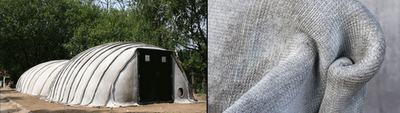
Emerging Objects 3D Prints Architectural Materials

Oakland-based Emerging Objects isn’t your normal design firm. Rather than designing homes, interiors, furniture or products from common materials, the four-person group is trying to create materials for tomorrow’s 3D printed objects.
 
Self-described as a “a pioneering design and research company that specializes in designing and 3D printing objects for the built environment using custom materials and processes,” Emerging Objects is interested in creating sustainable, inexpensive 3D printed buildings, building components and interior accessories.
Currently the group has six materials, acrylic, wood, nylon, salt, paper and cement polymer. Of all of the materials that the company employs, the one that’s most obviously beneficial is, of course, its cement polymer.
 
Read more at ENGINEERING.com
Thursday
May092013

Is Your 3D Printer Filament Toxic? 

You own a personal 3D printer that accepts 3rd party filament and you've purchased a selection of cool colors from an online shop - but is that filament safe? 
 
Aside from the obvious choices of color, quantity and filament diameter, the one factor most considered is price. Usually the lowest priced filament that meets the first four requirements wins your business. 
 
It's possible that the filament you purchased from an inexpensive overseas manufacturer contains a slightly different chemistry. Some regions do not have the same safety and materials standards as others, thus it's possible your cheapo filament may be toxic to some degree. 
 
Why would this happen, even if it was permitted? Additives are used to develop a full range of colors, and it's possible that certain colors make use of potentially toxic heavy metals. 
 
What can you do? We see only three choices: 
 
Accept the risk and continue your business as usual. You're probably doing this one already. 
 
Check with your filament supplier to ensure they provide non-toxic filament. While some vendors make a point of doing this, others may simply buy inexpensive filament from manufacturers just as you might. 
 
A third action you can take is to simply ventilate your PrintCave a lot more than you do now. Step away from that printer, go outside and get some fresh air. And do the other two steps, too. 
Wednesday
May012013

Get Your 3D Printer Filament at Makerstash Soon

We had the opportunity to meet with James Coleman, gentleman and founder of Makerstash, which will provide a wide selection of 3D printer filament for your MakerBot, RepRap or many other 3D printers. 
 
The filament business is straightforward, and success occurs simply by executing the business plan perfectly. MakerStash's Mission describes theirs: 
 
At MakerStash, our aim is to provide our top quality 3D printing supplies. We will ship orders quickly, provide excellent customer service, and be a resource for information about 3D printing and making. We want to give our customers every reason to come back and see us again. 
 
But what exactly do they do to achieve this? One aspect is quality control. Each filament is guaranteed to be within 0.05mm of the desired diameter - and 3D printer owners know what can happen when you receive uneven filament: stripped extrusions, failed prints and a lot of frustration. 
 
MakerStash also ships "by the foot" if you require only a small amount of filament. Gone are the days of having that 0.95kg spool of glow-in-the-dark purple polka-dot filament wasted because you're never going to use it again. 
 
This all sounds good, but there's one catch: MakerStash hasn't yet launched. For now you can sign up for notification of their official launch. We can't wait to see what they're offering. 
 
Tuesday
Apr092013

The Filastruder

The cost of a 3D printer is not only the printer itself, but also the print material. In most cases, personal 3D printers use plastic filament, either ABS or PLA plastic. If you're a prolific 3D print maker, you might actually spend more on plastic than you did on the 3D printer. 
 
How can this expense be reduced? You can shop around for the least expensive filament offered for sale, but another alternative might be the Filastruder. It's a new device just launched on Kickstarter that allows you to make your own filament - at a much lower price. 
 
The Filastruder project, by Tim Elmore of Florida, hopes to capitalize on the current price gap between filament and raw plastic pellets, from which filament is produced. Elmore suggests the price of filament can be ~USD$40 per kilogram, while raw plastic pellets can be had for only a "few dollars per kilogram". 
 
This is quite true. We took a quick look at sources of ABS pellets on Alibaba.com and found you could pick up large quantities of ABS pellets for as low as USD$1 per kg, if you're willing to buy a ton at a time. 
 
The Filastruder accepts such pellets, poured into a hopper, which then heats them to a precise temperature and then extrudes the melted plastic through an appropriately-sized nozzle to form filament. The filament collects on a spool which you can often drop directly into your 3D printer. 
 
The Filastruder is certified for use with ABS pellets, while they are still tuning the settings to ensure consistently shaped PLA filament. The device can produce 2-5 pounds of perfectly shaped ABS filament per day and is capable of running for "hundreds of hours"
 
The project was recently launched on Kickstarter with a fundraising goal of USD$5,000. Well, they are somewhat higher than that now, with well over USD$150,000 pledged. 
 
Just think: for a mere USD$300 for the Filastruder and USD$1000 for a truckload of ABS pellets you'll never need to buy any filament ever again. In fact, if you were to package up the filament and sell it, you might even make some money. 
 
Thursday
Mar212013

Materialise Announces Flexible Material

Materialise, the industrial 3D print service, has announced a rather interesting material: TPU 92A-1. Despite the awkward and mysterious nomenclature, TPU 92A-1 offers a legendary feature: flexibility. 
 
The video above shows the amazing flex provided by TPU 92A-1. Not only is this material flexible, but it also is resistant to tearing, temperature and abrasion, making it ideal for producing a new class of objects. What kind? Evidently TPU 92A-1 was used to produce the famous Iris van Herpen 3D printed dress earlier this year. 
 
We expect to see many functional objects start to emerge from Materialise's 3D printer farm, including not only dresses, but shoes, household objects and toys.
