
A new patent application from GE/Concept Laser proposes tighter real time control over laser energy in powder bed fusion systems.
Metal Powder Bed Fusion (PBF) has always required careful laser and material tuning. Operators can tune power, scan speed, hatch spacing, layer thickness and gas flow, but the actual melt pool is still affected by optics, contamination, component heating, powder behavior and the changing geometry of the part itself during the print job.
That is why closed loop control is so important in metal additive manufacturing. Most times, the technology has plenty of monitoring: coaxial cameras, pyrometers, melt pool sensors and layer imaging systems are now frequently encountered on higher end systems. But it’s a lot harder to tweak the energy input quickly enough to prevent problems instead of just documenting what happened for later analysis.
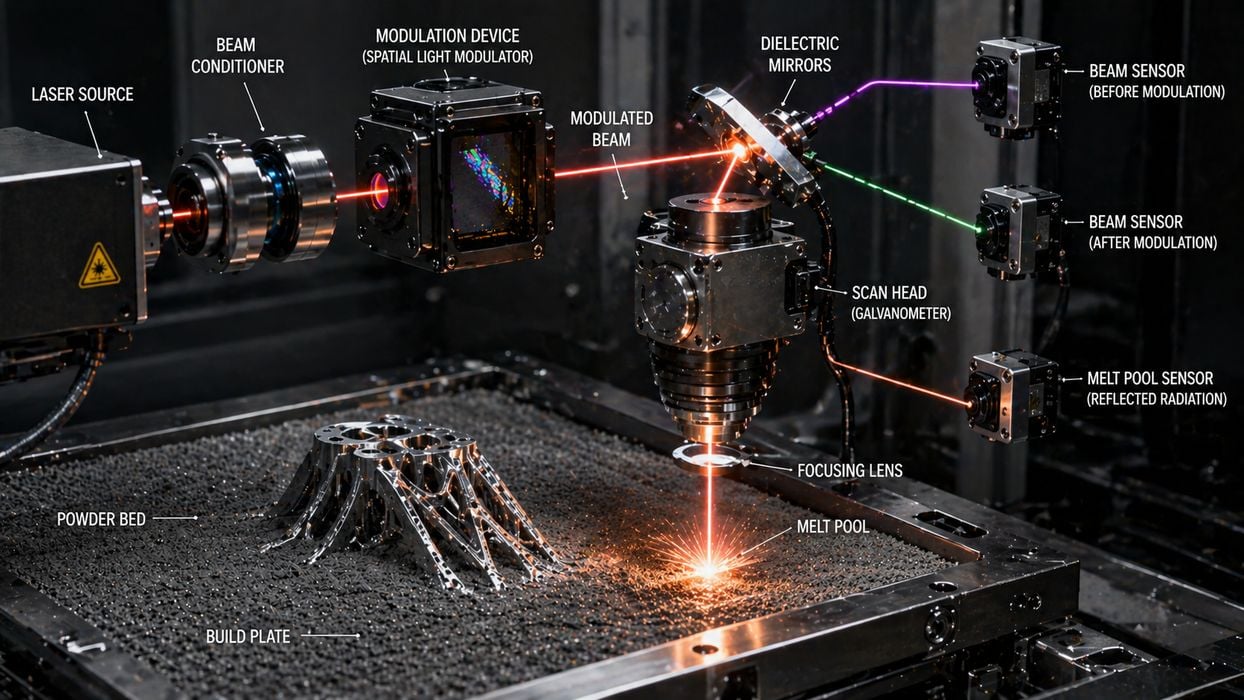
US patent application 20260115834, titled “Apparatus and Method for Additively Manufacturing Three-Dimensional Objects,” looks directly at that problem. The patent filing describes a laser based additive manufacturing system that measures both the modulated laser beam and reflected radiation from the build plane, then changes beam parameters dynamically during the build.
Watching The Beam And The Melt Pool
Their concept is for PBF and related laser processes, including Direct Metal Laser Melting (DMLM), Selective Laser Melting (SLM), Direct Metal Laser Sintering (DMLS) and Selective Laser Sintering (SLS).
The key addition is a modulation device placed downstream of the laser source. The patent specifically mentions spatial light modulators, including liquid crystal on silicon devices, digital micromirror devices, metamaterial devices, and other optical modulation systems. These devices can alter the beam’s amplitude, phase or polarization, which in turn changes the beam striking the build plane.
Today’s metal PBF systems almost always use a fixed optical scenario, aside from scan path and power changes. A more actively shaped beam could produce a Gaussian profile, a top hat profile, or even split a single beam into several focus areas. In other words, the machine could potentially control not only where the laser goes, but what the energy distribution looks like when it arrives. That’s quite different from most of today’s systems.
The patent describes multiple sensor paths. One set can inspect the conditioned laser beam before modulation. Another can inspect the modulated beam after the modulation device. A third can look backward through the optical path at reflected radiation from the build plane, including temperature or melt pool geometry.
This is the interesting part: the controller combines these signals and modifies defined parameters such as laser power, beam shape, amplitude, phase and polarization. The goal is to maintain target temperature distributions, compensate for machine drift, and possibly even customize the microstructure during the job.
That is a lot more ambitious than simple process monitoring. If it really works, it could help ensure printed parts are of more consistent quality, and likely more production reliability, too.
The obvious question is whether the response time of the system is fast enough to keep up with the scan motion. Another question is how this would fit into existing multi laser systems, where throughput and qualification already depend on careful optical calibration.
If GE/Concept Laser can make this a real capability, it may lead to better consistency, fewer failed builds and improved microstructural control. That would be especially relevant for aerospace, medical and energy applications, where process qualification is critical.
It’s important to know that this is just a patent idea for now, not a product announcement. But it does suggest an important direction: future metal printers may not simply fire lasers at powder; they may continuously reshape the light based on what the machine sees happening.
Via USPTO
