
Sponsors

Recommended
  • Rule 34
    Rule 34
    by Charles Stross

    Stross delves into a possible future where 3D printers become commonplace - and explores the problems that could result. 

  • Printing in Plastic: Build Your Own 3D Printer (Technology in Action)
    Printing in Plastic: Build Your Own 3D Printer (Technology in Action)
    by James Floyd Kelly, Patrick Hood-Daniel
  • 3Dconnexion SpaceNavigator SE (Standard Edition) 3D Navigation Device USB ( 3DX-700028 )
    3Dconnexion SpaceNavigator SE (Standard Edition) 3D Navigation Device USB ( 3DX-700028 )
    3D Connexion
  • The Homebrew Industrial Revolution: A Low-Overhead Manifesto
    The Homebrew Industrial Revolution: A Low-Overhead Manifesto
    by Kevin A. Carson
  • Mastering Blender
    Mastering Blender
    by Tony Mullen
  • Kindle Wireless Reading Device (6
    Kindle Wireless Reading Device (6" Display, Global Wireless, Latest Generation)
    Amazon.com
  • Blender 3D 2.49 Incredible Machines
    Blender 3D 2.49 Incredible Machines
    by Allan Brito
  • Makers
    Makers
    by Cory Doctorow
  • 3Dconnexion SpacePilot PRO - 3D motion controller - 31 button(s) - wired - USB
    3Dconnexion SpacePilot PRO - 3D motion controller - 31 button(s) - wired - USB
    3D Connexion

Entries in hp (11)

Monday
Feb272012

HP Launches a New 3D Printer. Not!

We suddenly awoke to read the startling headline: "HP launches new 3D printer" and envisioned a grand update to HP's long-term relationship with Stratasys. Perhaps a new low-cost 3D printer is now available? Maybe even a consumer version? 
 
Um, no. 
 
They launched the HP Topshot Laserjet Pro M275 in the UAE today. What makes this Laserjet 3D? It can apparently capture images of 3D objects and convert them into 2D images. Very useful if you don't have a camera and studio and need to quickly create an image for your new handheld product. All yours for AED1,499 (USD$408). 
 
But it's not a 3D printer. 
 
Wednesday
Dec212011

Stratasys Drifting Away from HP?

In early 2010 big-time 3D printer manufacturer Stratasys signed an agreement with even-bigger-time 2D printer manufacturer HP to market 3D printers. The deal involved Stratasys producing HP-labeled printers that would be marketed through HP's massive reseller networks. They started sales in Europe later that year.  
 
Now we see this arrangement may not be proceeding as originally intended, at least according to a report on investment blog Seeking Alpha. Here's what they say:
 
The company originally had high hopes for its H-P relationship (which was aimed at the engineering segment) but the larger company dragged its feet, holding back performance. Last summer Stratasys essentially threw in the towel and reinstituted its own marketing efforts in lieu of H-P. 
 
Ouch! This move was at first thought to be a potential major breakthrough, taking 3D printing from its current niches into a much wider and possibly more mainstream market. But apparently it has not come to pass, in spite of relatively recent statements from HP to the contrary, at least according to the report. 
 
Does this imply a setback for the progress of 3D printing? We think not. Stratasys and its competitors, as well as the multitude of smaller manufacturers are all growing at steady or even record rates. Progress will happen, HP or not. 
 
Friday
Jun172011

HP 3D Printing Update

At the recent Plastics Design and Moulding show in London, Fabbaloo caught up with Eric Erickson, HP's Product Manager for their Designjet 3D printers.  
 
It's been over a year since it was announced HP would market 3D printers through an agreement with Stratasys. How well has business been over that period? Has HP found this venture profitable? 
Yes, we announced our entrance into the 3D printer market in January 2010 and started selling almost exactly one year ago. It has been a fascinating year for 3D printing, and I while I can't discuss profitability directly I can say that HP is pleased with the results so far!
HP's 3D printers are not priced at consumer levels, so what specific market is HP addressing?
We are currently selling to 2 types of customers: technical professionals who need to make models and prototypes as part of the design process in order to optimise designs and reduce costs, and to education for students who are learning to use modeling and prototyping technologies as part of a technical curriculum.
HP is well known for its 2D paper printing, but how did HP decide to venture into 3D printing?
About 5 years ago I was asked to investigate the feasibility of HP getting into this market. We initially saw that, in terms of the current adoption of 3D printing, there was an attractive market overlap with our Designjet line of large-format printers (i.e. our Designjet customer base could also be interested in acquiring a 3D printer). Based on this I did a complete market analysis, and as interest grew internally, so did the team and we were able to convince management that now was the time to enter this market.
Currently you market HP 3D printers only in five European countries. Do you have plans to expand your scope, and if not, what barriers hold you back? When might we see HP 3DP appear in North America?
There are no barriers holding us back; the reason we started in the 5 European countries was because the Designjet headquarters is in Barcelona and we thought it logical to grow from our core geographically. I don't yet have any expansion plans that I can share publicly.
We understand HP's 3D printers are designed and manufactured by Stratasys. How is the relationship with Stratasys? Will we see new 3D printers emerge in the future?
The relationship is going very well and while I would expect to see new models in the future I don't have anything that I can share publicly.
Thursday
May132010

HP 3D Printers Rolling Out

NeBusiness reports on the new HP 3D printer that's now in the hands of another UK reseller: Standing Stone. They've been selling it since the first of May. The firm's national sales director, Simon Buckton, says of the £16,500 3D printer + cleaner combo:
 
We’ve shown some architects, who are very excited about it, because it turns a visual concept into something substantial. The car-making and engineering industries will benefit from this too, and we’ve had Newcastle University looking at it very carefully because the cost of making the models themselves is just a few pounds once you’ve bought the machine.
 
Here's the interesting bit: Standing Stone believe's they'll be able to score four sales per month (that's almost 50 3D printers this year from this reseller alone!) and across the UK it "could be worth £1m to £2m in the next 12 months."
 
Saturday
May082010

Stratasys is Savoring

That's according to their CEO, Scott Crump, who in a recent blog post described the moment when HP announced it entered the 3D printer market - using machines made by Stratasys. Crump:
 
It’s a sweet feeling to see Stratasys reach this point. I’ve envisioned an event like this for more than 20 years.
 
By expanding into 3D printing, HP is taking an historic step. It’s the only paper printer manufacturer that competes in the 3D printer market space.
 
We still have a ways to go, but 3D printing is on its way to becoming mainstream.
 
We think so too. But this is a fabulous first step. 
 
Thursday
Apr292010

HP 3D Printer  Specifications

While the new line of HP 3D printers is only available in certain countries, that doesn't stop you from finding their specifications if you aren't in their current sales area. We've probed to the depths of HP's vast ocean of web pages to find the specifications for the twin 3D printers announced last week.  
  
As we mentioned before, there are two printers at this time, the plainly named Designjet 3D Personal Printer, priced at £11,050 (USD$17,000), and the Designjet 3D Colour Printer priced at £14,260 (USD$22,000). But what are their capabilities?
 
Since both models are based on the same framework, let's examine the characteristics that are the same between the two:
  • Both employ the "HP DesignJet 3D Removal System", which we suspect is in fact the Stratasys WaveWash system we wrote on yesterday. The printers require a "Water inlet and outlet for the HP Designjet 3D Removal System". This appears to be an optional feature implemented in a separate box. 
  • Both use ABS plastic as their build medium, and can hold spools up to 655 CC's. There's an option for a second material bay, doubling the capacity to 1310 CC's. 
  • Several productivity features inherited from Stratasys's mature product line, including optimized support structure design and build; auto-orientation to ensure builds are quick and efficient.
  • Both models consume 1200 Watts of power, and weigh 59 Kg. 
  • Contemporary versions of Microsoft Windows are required for the associate software. 
  • A one-year warranty is included, but you can choose among a wide variety of multi-year support plans that range in price from a one year plan at £1158 (USD$1800) to a five year plan on the color model for £5250 (USD$8000).
 
Ok, but what's the difference between the Designjet 3D Personal Printer and the Designjet 3D Colour Printer? Read that line again and it's pretty clear: Color! The color model is capable of printing in eight colors (ivory, black, red, olive green, nectarine, fluorescent yellow, blue, gray), if you choose to purchase spools of those particular shades. All material cartridges seem to cost £650 (USD$1000). Other than that, the color's build chamber is a tad larger, 203 x 203 x 152 mm rather than 203 x 152 x 152 mm. Oh yeah, and the price, that's slightly different, too.  
 
Via HP UK
Monday
Apr192010

HP is 3D Printing!

The big news today was the anticipated release of HP's new line of 3D printers. The printers are actually made by Stratasys, makers of the Dimension line of printers by means of a joint venture the two signed earlier this year
 
The announcement specifies two models, which will be available this May only in France, Germany, Italy, Spain and the UK. From LaserLines, one of the initial product resellers:
 
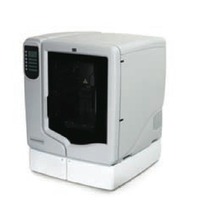
  • The Designjet 3D Personal Printer (pictured above), priced at £11,050 (USD$17,000), is a true desktop model that's only 0.6m square based on Stratays' existing technology. 
  • The Designjet 3D Colour Printer priced at £14,260 (USD$22,000) provides a slightly larger build chamber and the ability to print in up to seven different colors.  
 
Both packages include software, material, soluble support, cables and other necessary bits that should enable you to get started right away. 
 
While product specifications seem a bit skimpy today, we anticipate the devices will offer capabilities, capacities and speeds similar to Stratasys' other products - meaning very high quality and a lot of very useful options. We think HP selected well here, as Stratsys has many years of experience developing what is now a very mature product line. As manufacturing and product experience increases, we figure HP will offer the devices in other markets later this year. 
 
Are these devices for everyone? Definitely not, the near USD$20K price is well beyond home and hobbyist users - but it could be within the price range for small offices, architectural firms and others who want to go beyond using 3D print services. This is big news - simply because there will soon be an awful lot more 3D printers in the world, and that can't hurt at all. 
 
Friday
Mar262010

HP Ready to Ship 3D Printers

In an update to the blockbuster announcement in January, DesignNews reports that HP will very soon begin shipping their new 3D printers to five selected European countries, eventually widening their market to the entire globe. The printers are being manufactured by HP's partner and 3D printing leader, Stratasys at their Minnesota plant. 
 
DesignNews believes Stratasys must "dramatically ramp up" their assembly plant capacity to accommodate the demand for the new printers. They suggest that demand could grow from today's 4,000 commercial units sold annually to as much as 50,000 per year. OMG!
 
If that's so, then our suspicion that HP's massive market presence would drive huge demand may become true. This can only be good for 3D printing, regardless of which device you prefer, because general knowledge of the technology will increase significantly. But let's wait to see what HP will offer. Has anyone seen the specifications?
