
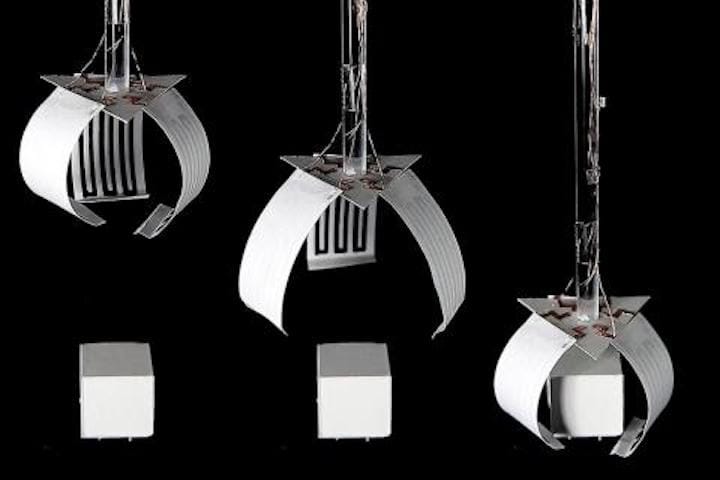
![Mechanical devices made from paper and 3D printed graphene [Source: CMU]](https://fabbaloo.com/wp-content/uploads/2020/05/image-asset_img_5eb0a4f1ed656.jpg)
New research shows an interesting approach for producing mechanical paper devices with 3D printing.
Researchers at CMU realized that certain conductive thermoplastics could heat and expand. This property was thought to be useful as a kind of electrically controlled muscle.
The researchers then 3D printed specifically designed layers on top of paper, where the soft thermoplastic would adhere to the surface. Once attached to the paper, an electric current was applied and the 3D printed elements would expand.
The prints were designed to push the paper in specific directions upon expansion, creating simple mechanical devices. There are many possible uses, as the researchers explain:
“These enable the creation of structures that can turn themselves into balls or cylinders. Or, they can be used to construct more elaborate objects, such as a lamp shade that changes its shape and the amount of light it emits, or an artificial mimosa plant with leaf petals that sequentially open when one is touched.”
Researchers used a graphene composite filament to provide the electrically conductive material for their experiments. Their workflow is a bit different from typical 3D printing operations:
-
A 0.5mm layer of conductive material is 3D printed in the desired shape on a flat piece of paper
-
The paper is removed from the printer and cut to the desired shape
-
The object is heated with a heat gun to slightly soften the 3D printed graphene material
-
The object is folded into its final shape
-
The object cools and is ready for electrical application
Paper actuators are not particularly strong, but there are many applications that do not require strength, particularly those involving light. I can imagine some very interesting venetian blinds being made with this process.
And one more thing: Graphene filament is a material that is easily available to almost anyone having access to a common desktop 3D printer using the plastic extrusion process. Thus it is entirely possible for many 3D printer operators to attempt such a process, and it would not require much filament either.
But it would require a careful design that in many ways parallels typical mechanical designs, yet this would be a single-piece solid 3D print.
Via CMU




A research thesis details the incredibly complex world of volumetric 3D printing. We review the highlights.