
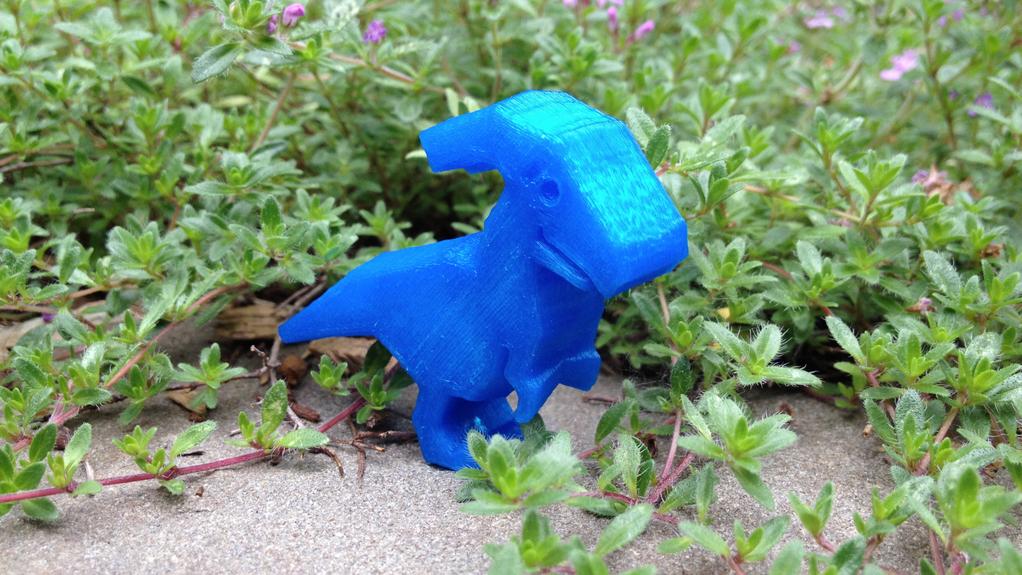
Recently we wrote of a newly encountered 3D model repository, dayin.la, which holds plenty of interesting 3D content, but now it seems the site has used some models without permission.
The site in question, dayin.la, is a Chinese service offering hundreds of 3D models for download in a manner very similar to Thingiverse. It’s in Chinese, so few non-Chinese users might have encountered it, but we found it and through the magical use of Google Translate, were able to succesfully navigate through to downloading 3D models.
We did not review the entire collection, as the site contains perhaps thousands of 3D models. But one Fabbaloo reader, Jim Rodda (aka Zheng3), went through the site and found that at least one of his 3D models was on the site and available for free download.
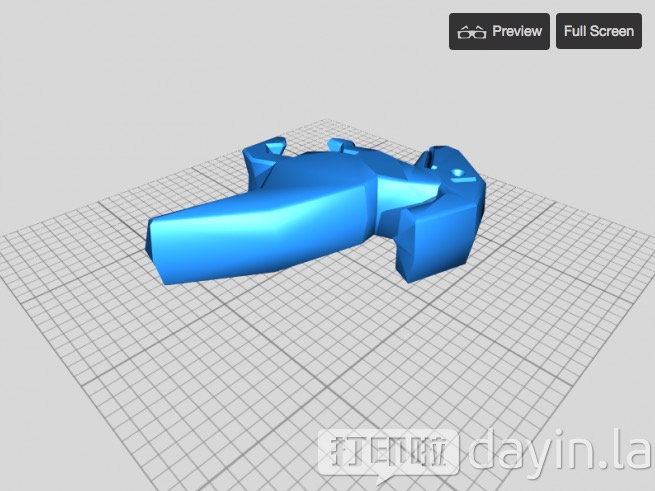
We asked Rodda (a speaker of Chinese) to describe what happened after finding the site via Fabbaloo’s post:
I found day in (translates to “printer,” BTW) through Fabbaloo’s tweet. I decided to multiplex practicing Chinese and searching for my models by entering 恐龙 (dinosaur) into the search field. I expected to find Robber Rex, because he’s more popular, but lo!
There was Milton. It’s a shame it had to be Milton, because as dinosaurs go he’s pretty anxious and I’m concerned for how this will affect his self-esteem. (Milton’s anxiety issues are well-documented here.
On Zheng3’s site, the model in question, “Milton”, shown at top, is marked with this license:
Unless otherwise specified, all models from the Forge are distributed under the Creative Commons Share-Alike license, so you’re free to share and remix them as long as you credit Zheng3.com. You can also send a donation to [email protected] to help keep The Forge stocked with anthracite and ale. Thanks.
It’s otherwise fully downloadable at no cost. This license makes it easy for personal use of a 3D model, but requires appropriate attribution if you’re redistributing it in some way. The same way dayin.la seems to be doing.
But did dayin.la provide such attribution?
Apparently not. A Google translation of the item, “Simple small dinosaur” reads as follows:
Model Description
Simple model of small dinosaur
The entry not only does not recognize the attribution, but the item’s name has been changed from “Milton” to “Simple small dinosaur”.
This transgression may not be directly caused by dayin.la, as it may have been one of their users who have uploaded the model; the service may not be aware of the model’s heritage. However, the site does offer a way to make a correction: a button brings up this box (translation again courtesy of Google):
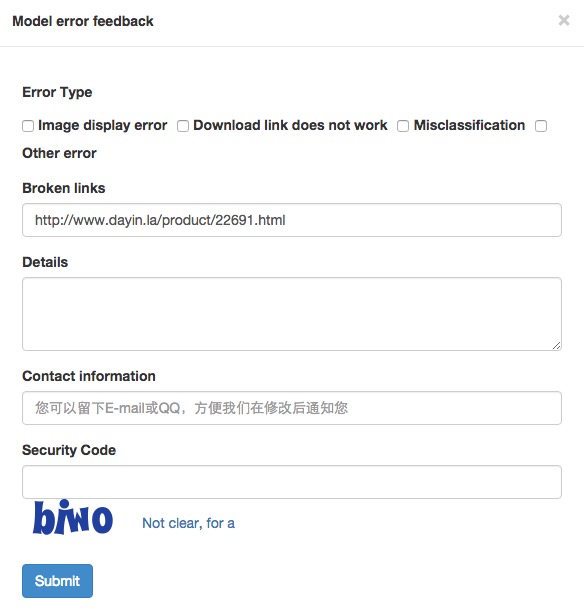
From there it would be possible to provide the appropriate change information to the 3D model, that presumably dayin.la would implement.
What are Rodda’s plans? He explained what he will do next:
I’m a little peeved about the situation, but I understand it. You can’t expect every kid in China with an internet connection to know what a Creative-Commons Share Alike license is. Heck, you can’t get people for whom English is a first language to follow that license sometimes.
My thinking is that since I can’t beat ‘em, imma join ‘em. I’m going to create an account on day in and start uploading all the models from The Forge. It’ll be a good way to learn some new vocabulary and engage with a new set of 3D printer owners who aren’t comfortable on Western model sites. I have no idea how I’m going to translate all those model descriptions though.
Is there other content that may require similar adjustments or perhaps even removal if the content is proprietary? It appears so. By digging deeper, we found several 3D models that, at first glance, could be licensed items, including a small number of Iron Man, RoboCop, Simpsons pieces and a collection of League of Legends items. It’s possible there are items appearing in the same way as Zheng3’s, so we advise designers to take a look through the site and report any corrections.
