
Subscribe


Subscribe by Email. Enter address:

Search

Powered by Squarespace
Sponsors

Recommended
  • Fabricated: The New World of 3D Printing
    Fabricated: The New World of 3D Printing
    by Hod Lipson, Melba Kurman
  • Getting Started with MakerBot
    Getting Started with MakerBot
    by Bre Pettis, Anna Kaziunas France, Jay Shergill
  • Bend, Not Break
    Bend, Not Break
    Portfolio
  • Makers: The New Industrial Revolution
    Makers: The New Industrial Revolution
    by Chris Anderson
  • Makers
    Makers
    by Cory Doctorow
  • 3Dconnexion SpaceNavigator SE (Standard Edition) 3D Navigation Device USB ( 3DX-700028 )
    3Dconnexion SpaceNavigator SE (Standard Edition) 3D Navigation Device USB ( 3DX-700028 )
    3D Connexion
  • Printing in Plastic: Build Your Own 3D Printer (Technology in Action)
    Printing in Plastic: Build Your Own 3D Printer (Technology in Action)
    by James Floyd Kelly, Patrick Hood-Daniel
  • The Homebrew Industrial Revolution: A Low-Overhead Manifesto
    The Homebrew Industrial Revolution: A Low-Overhead Manifesto
    by Kevin A. Carson

Entries in ceramic (14)

Thursday
Dec132012

Rapid Ceramic Engineering

Ben Becker of HotEnd Works described to us the process his company uses to produce industrial-grade ceramic prototypes. Ceramic prototypes have been around for a very long time, but there's only so much you can do using conventional prototyping tools. Some geometries simply cannot be produced. 
 
However, 3D printed ceramics can replicate any geometry. But one of the issues is that most ceramic processes seem to use 'art-grade' ceramics that are entirely unsuitable for engineering-level prototypes. HotEnd Works avoids this scenario by using different ceramic materials. Becker says: 
 
Materials used in rapid ceramics range from less hard alumina ceramics (aluminum oxide filler) to very hard and abrasion resistant zirconia ceramics (zirconium silicate filler). These ceramics can withstand between 2800 F and 3200 F working temperatures, and have a dielectric strength of 150 volts per mil. The alumina ceramic material is extremely abrasion resistant, corrosion resistant, and has excellent mechanical performance. 
 
There are many different processes for 3D printing, but the choice of materials is just as important. Choose wisely.
 
Wednesday
Dec052012

The CeraFab 7500 3D Printer

We spoke with Dr. Martin Schwentenwein, who's associated with Lithoz, a new Austrian company based in Vienna that has just developed a brand new ceramic 3D printer, the CeraFab 7500.  
 
This fridge-sized device is specifically designed to 3D print ceramic materials. Lithoz's LCM technology prints Objects by repeatedly photo-curing whole layers within a slurry of ceramic particles and a binder. After printing the object is then fired in a furnace to burn out the binder and fuse the ceramic particles into its final form. 
 
The results are stunningly beautiful; they require no finishing beyond the final firing to form their smooth, layer-less texture. Evidently the accuracy is in the 0.1mm range, but it seemed even finer when examining some sample prints. Check out the detail on this item. What you can't see is the strength of this material. You'd find it very difficult or even impossible to crush this cube using your fingers alone. 
 
The device has just been released so we are not certain of its final price, but we suspect it will be in the €200,000 range when it hits the reseller market. 
 
Via Lithoz
Saturday
Nov102012

i.Materialise Reduces Ceramics Price

If you've got a model requiring a cubic centimeter of ceramic to print, i.Materialise can print it for you at a lowered price of USD$0.18. 
 
Their ceramic material is particularly useful due to its smooth appearance, wide variety of kitchy colors, heat resistance and the fact that it's food safe. You can produce functional items in ceramics that you simply cannot in plastic. Think, "Dishwasher Safe". 
 
Tuesday
Nov062012

Printing Bricks

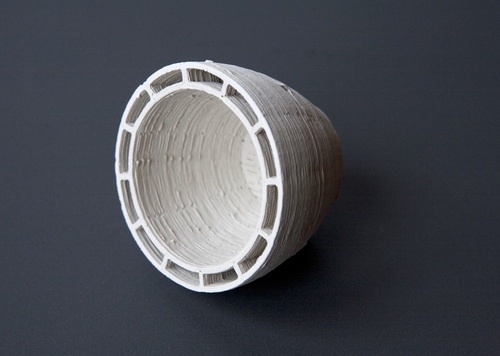
Fabbaloo readers are most familiar with the idea of 3D printing plastic, metal or sometimes food, but how about bricks? The method of making common ceramic brick for centuries is giving way for an experiment in 3D printing building bricks. 
 
The experiment is being conducted by Building Bytes, who have already designed three styles of brick prints: Interlocking, Ribbed, Honeycomb and something they call the "X-Brick". Their method is to use a liquid ceramic air pressure-extruded from a standard personal 3D printer (which looks suspiciously similar to a BFB RapMan.) 
 
But, you ask, why incur the lengthy delays 3D printing bricks when they can be made much faster using conventional approaches? The answer lies in the design of the bricks.  
 
A 3D printed brick has far more opportunity for ingenious design than a standard rectangular brick. The printed brick could include complex exterior surfaces to permit different types of interlocking or curvature of final structure. The internal structure of the brick could be engineered to significantly lower the brick's weight or beef up the strength required at stress points for a particular build. 
 
Will 3D printed bricks replace conventional approaches? Definitely not, but the concept could introduce entirely new specialized brick types. 
 
Thursday
Sep272012

An Interview with the Ceramics Master

We managed to obtain an exclusive interview with one of the world's leading print researchers, Professor Stephen Hoskins. Professor Hoskins' group has recently been investigating the potential of 3D printing. 
 
Fabbaloo: You're the Hewlett Packard Professor of Fine Print and Director of the Centre for Fine Print Research at the University of the West of England. Can you tell us what the Centre does? 
 
Stephen Hoskins: At the Centre for Fine Print Research (CFPR) at the University of the West of England, our research explores all aspects of print and printing technologies, from traditional 19th Century printmaking processes to the most up-to-date technologies in rapid prototyping and Additive Layer Manufacturing. At the CFPR we have a strong interdisciplinary team which includes print artists and 3D designers as well as technologists and industrial specialists, and much of our research takes places at the intersection of art, science and creative technologies. We regularly enjoy collaborating with leading international artists as well as high-technology companies such as Hewlett Packard and Roland, with the aim of extending the range of creative applications for print technology. 
 
Fabbaloo: Have you been experimenting with 3D printed ceramics? What have you discovered? 
 
Stephen Hoskins: Here at CFPR we have been working for some time on the 3D printing of ceramics by the powder-binder method (Z-Corp). We have developed a new 3D printable ceramic powder which is compatible with the Z-Corp 3D printing process. This means that objects can be designed on computer, 3D printed, and then fired in a kiln and glazed in the traditional way. The ceramic material has been developed by CFPR Research Fellow David Huson, and myself and has been patented and licensed to the American company Viridis 3D with whom we are collaborating with to commercialise the results of our research. 
 
Fabbaloo: We understand you've been working on some interesting projects. Can you describe some of them? 
 
Stephen Hoskins: Following on from our research into the 3D printing of ceramics, we have just received a large funding grant from the UK's Arts and Humanities Research Council to develop a self-glazing 3D printable ceramic material. This project will investigate Ancient Egyptian ceramic recipes and explores the potential for a 3D printable ceramic body which can be fired and glazed in one firing. Another area of our research explores 3D printing and “smart” artificial muscle materials for applications in robotics and interactive art. One outcome of this research is a 3D printed “smart” robotic tentacle which moves in a lifelike way when stimulated by an electric current. This work was reported here by Objet Geometries, including a video of the tentacle in action.
  
Fabbaloo: Ceramic prints would not likely be used for industrial applications; do you see a future for artistic applications of 3D printing vs. industrial parts production? 
 
Stephen Hoskins: We get an awful lot of enquiries from a whole range of industries who see potential for our ceramic 3D printing material for use in technical and industrial applications. Many of these potential applications are commercially confidential so it is not possible to go into detail here, however it is clear to us that the 3D printing of ceramics results in some unique physical properties not normally seen in conventionally formed ceramics. Because we work with industry as well as the visual arts and design, we are therefore in a strong position to exploit the artist and technological outcomes of our research. 
 
I have just been interviewed by the AHRC and the film can be found here
Saturday
Aug252012

Ponoko's Badass Black

Ceramic 3D printing services are not exactly new, but there are limits to the colors offered by popular 3D printing services. Ponoko has announced the availability of black ceramic material. 
 
Previously Ponoko offered a variety of pastel-ish colors, including Green, Pale Blue, Peach, Periwinkle, Teal, White and Yellow. The new colors include a choice of gloss or satin finish. 
 
We think black is a great color for ceramics. The pastels are interesting, but their applicability to designs is more limited than white or (now) black. Black, an important ceramic color - or as Ponoko describes it, their "badass black".
 
Via Ponoko
Wednesday
Aug152012

i.Materialise Introduces Ceramics


3D print service i.Materialise has announced the availability of ceramics as a print material. They aren't the first to introduce commercial ceramics print capability, but it's an excellent capability improvement for them. 
 
Ceramics offers a few key advantages over other materials: 
 
  • Heat resistant up to 600C (1112F)
  • Ultra-smooth finish with no visible build ridges
  • Shiny surface
  • Food safe
 
That's correct - with ceramics you can safely 3D print items for your kitchen cupboard, such as cups, dishes, etc.  
 
The ceramics option is offered in several possible colors: 
 
  • Glossy white
  • Glossy Black
  • Lemon Yellow
  • Pistachio Green
  • Sky blue
  • Ocean Turquoise
  • True blue
  • Peach Orange
 
i.Materialise charges not by volume as is typically done, but instead by surface area. Must have something to do with the glazing process. Pricing is dependent on color, with Glossy White being the least expensive at USD$0.18 per sq cm of surface area and the most expensive being the non-black colors at USD$0.20 per sq cm.  


Sunday
Jul222012

Ponoko's Color Ceramics

Ponoko has announced the availability of seven different colors for their glazed ceramic 3D printing material. 
 
They previously offered four colors, but now add Yellow, Green and Pale Blue. Even better, they're offering a discount of 10% off any orders using glazed ceramic until July 29th. 
 
Now you can make that coffee cup with the color you always wanted. Yellow, wasn't it? 
  
Via Ponoko
