
Subscribe


Subscribe by Email. Enter address:

Search

Powered by Squarespace
Sponsors

Recommended
  • Fabricated: The New World of 3D Printing
    Fabricated: The New World of 3D Printing
    by Hod Lipson, Melba Kurman
  • Getting Started with MakerBot
    Getting Started with MakerBot
    by Bre Pettis, Anna Kaziunas France, Jay Shergill
  • Bend, Not Break
    Bend, Not Break
    Portfolio
  • Makers: The New Industrial Revolution
    Makers: The New Industrial Revolution
    by Chris Anderson
  • Makers
    Makers
    by Cory Doctorow
  • 3Dconnexion SpaceNavigator SE (Standard Edition) 3D Navigation Device USB ( 3DX-700028 )
    3Dconnexion SpaceNavigator SE (Standard Edition) 3D Navigation Device USB ( 3DX-700028 )
    3D Connexion
  • Printing in Plastic: Build Your Own 3D Printer (Technology in Action)
    Printing in Plastic: Build Your Own 3D Printer (Technology in Action)
    by James Floyd Kelly, Patrick Hood-Daniel
  • The Homebrew Industrial Revolution: A Low-Overhead Manifesto
    The Homebrew Industrial Revolution: A Low-Overhead Manifesto
    by Kevin A. Carson

Entries in bioprinting (24)

Wednesday
Aug222012

Modern Meadow's Meats' Organovo Roots

A new bioprinting startup suddenly appeared: Modern Meadow, courtesy of a small investment by Internet billionaire Peter Thiel. It's goal is to develop lab-grown "food grade animal protein", also known as "meat". The idea is to produce the protein without the massive environmental cost of actual cows, pigs and other meat-laden critters. Their one-line pitch reads: 
 
Applying latest advances in tissue engineering to create meat and leather without the need to raise, slaughter and transport animals.
 
This is an interesting and possibly necessary development in the long term, but research we've heard of suggests the current state of the art in lab-grown beef is that it's not particularly edible. The texture is the issue. Or rather lack thereof. 
 
Perhaps this could be solved by using 3D bioprinting techniques, which could theoretically arrange beefy bits into appropriate 3D meat sinews? One company we know is investigating that technology is Organovo, of whom we're written a few posts lately. 
 
But wait! If we look at the list of management for Modern Meadow, we find Andras and Gabor Forgacs, the CEO and Chief Scientific Officer of Organovo. Are they still at Organovo? Organovo's site says: "Prof. Forgacs continues to closely advise Organovo", and there is no mention of Andras. 
 
What does this mean? We're not sure, but after the recent spectacular rise and sudden fall of Organovo's stock, it may suggest investors be wary. 
 
Via Gust
Sunday
Aug052012

What's Down With Organovo?

A few short weeks ago we wrote a piece entitled, "What's With Organovo?", in which we pondered why the stock price of this bioprinting startup soared beyond belief. It seemed at the time there was no reasonable explanation for the stock price's stratospheric behavior. 
 
This week the answer has appeared: there really was no reason for the stock to be that high. From the soaring heights of a price near USD$11, the price has now collapsed back to its apparently "normal" level just under USD$2 per share. Seeking Alpha writes: 
 
The company is loaded up with debt, bleeding cash and generates little to no revenue. While the technology is amazing and the potential is huge, right now the company is generous in its filings when it says it will be able to pay the bills for the next 12 months.
 
That said, Seeking Alpha goes on to say that in the long term this company may gradually build up to its potential, but that investors had better be aware of what they're getting into. 
 
We're staying on the sidelines, too. 
 
Monday
Jul092012

3D Printing Sugary Blood Vessels

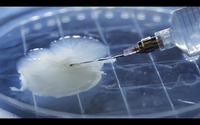
A new breakthrough in medical 3D printing: researchers at the University of Pennsylvania have developed a method of creating living tissue using 3D printing technology. 
 
The researchers were concerned with the limitations of current bioprinting techniques, which are able to print layers of living tissue, but are less able to create the necessary  vasculature (i.e. blood vessels) that ensure the living tissue stays living. 
 
Their solution is actually quite straightforward: 3D print a "negative" of the desired blood vessels using sugar. This print would represent the spaces through which blood would flow. Then a solution of living cells is poured around the sugary framework. The cells then tend to grow around the sugar structure in the correct positions to assume the shape of the required blood vessels. Finally, the sugar dissolves leaving the tissue and vasculature. 
 
The researchers determined by experiment the correct sugary formulation, which turned out to be a mix of sucrose, glucose and a dash of dextran to ensure solidity. The part we found most interesting was the device they printed the sugary framework with: a modified RepRap open source 3D printer! 
 
This technique could vastly simplify the eventual production of more complex living tissue. But will you be able to do so with your home 3D printer? 
 
Via UPenn and YouTube (Hat tip to Gary)
Sunday
Jul012012

Bioprinting Advances

Bioprinting is something you'll be hearing a lot more about in the future. It's the application of 3D printing for medical purposes. 
 
The idea is to produce human tissue for replacement of damaged portions, but it's much more complicated than 3D printing simple plastic objects. Not only are you dealing with microscopic bits, but they are also alive! 
 
The process typically involves printing a "scaffold" made of a dissolvable material that supports the actual living cells extracted from the patient to avoid "tissue rejection". The cells then grow over the scaffold and when it eventually dissolves, you've got tissue cells organized in the correct manner. Additional complexities arrive when you consider that human organs involve many different kinds of cells, unlike typical 3D printed plastic objects that are made from a single material. 
 
ABC News interviewed Dr. Anthony Atala, who's leading a team of 300 researchers at the Wake Forest Institute for Regenerative Medicine in North Carolina. He's been experimenting with growing replacement organs based on cells from the patient and has been quite successful. Starting from growing a replacement human bladder in 1998, the team is now testing 30 different human organs and various body tissues. For example, they've developed techniques to seal battle wounds by printing healthy skin cells over the damaged area. They're still working on actual organs, which obviously are much more complex.
 
Is this approach ready for regular hospital use? Not quite. It still involves significant work by teams of people to ensure a successful result. However, as research continues it's likely efficiencies will be identified and implemented, leading to a future where you'll be able to grow your own replacements. 
 
Wednesday
Jun202012

What's With Organovo?

You may recall Organovo? They're a bioprinting startup that is attempting to 3D print a variety of biological tissues, including Actual Human Organs! They say: 
 
Organovo's powerful NovoGen Bioprinting platform creates human tissues starting with any cell source. From disease models to tissue creation, bioprinting solves urged needs in biological research.
 
Their goal is to bioprint whole human organs, but they've been surviving by bioprinting simple tissue on scaffolds used for drug testing. This hasn't been vastly profitable, as far as we can see: their most recent financial statement indicated they suffered a USD$4.4M loss in 2011, somewhat worse than their 2010 loss of USD$1.3M. 
 
So why are we concerned with Organovo? 
 
In the past few weeks their stock price has risen sharply from the near penny-stock range of $1.50 to just under $10. Why has their stock risen by a factor of six?
 
The media coverage has exploded in recent days, including articles from sbdn, Investment U, The Atlantic, Seeking Alpha and KapitallWire. Even the White House has said a few words about it, with VP Joe Biden saying, "It’s literally around the corner."
 
What's going on with Organovo? We see only that they've hired a new chief strategy officer, Dr. Eric Michael David and prior to that had beefed up their management team slightly. 
 
Do you know something we don't know? 
 
Friday
Mar022012

3D Printing Muscles

Organovo, the 3D Bioprinting startup, announced they've received USD$6.5M in a private placement investment to bolster their research budget. 
 
Organovo has been working on the problem of 3D printing live human tissue - but not with the intention of surgically inserting said tissue into live humans. No, instead they wish to create live human tissue in such a way to permit drug and therapy testing without involving human or animal subjects. According to Keith Murphy, Organovo CEO: 
 
Organovo's advanced bioprinting platform can replicate essential biology for research, drug discovery and development and, eventually, for therapeutic applications. We have found success in achieving early revenue through strategic collaborations, and this funding will allow us to extend the reach and uses of 3D bioprinting through growth and innovation in the coming years.
 
Friday
Sep302011

Printing Blood Vessels

Printing solid objects is pretty easy: you just extrude/fuse/sinter/flash the layers and you've got your whatever-it-is-you-wanted. It's easy because typically these 3D prints are a uniform material all the way through. Occasionally experiments are done with multiple materials and one commercial 3D printer maker (Objet) has a technology that can print mixes of two different materials, but by and large 3D printed objects are pretty simple in structure. 
 
This is why Bioprinting is so hard. When you want to print living material, it's different because live tissue is a machine composed of many different internal parts, working together to maintain life. A key component is, of course, blood vessels. If you were to print a chunk of living cells (and some have done so), it isn't going to survive very long unless you're able to deliver life-sustaining nutrients to that tissue via blood vessels and microscopic capillaries. 
  
However, researches at the Fraunhofer Institute in Germany have been working on this very issue and appear to have made some breakthroughs. According to Fraunhofer: 
 
3-D printing technology is still too imprecise for the fine structures of capillary vessels. This is why these researchers combine this technology with two-photon polymerization. Brief but intensive laser impulses impact the material and stimulate the molecules in a very small focus point so that crosslinking of the molecules occurs. The material becomes an elastic solid, due to the properties of the precursor molecules that have been adjusted by the chemists in the project team. In this way highly precise, elastic structures are built according to a 3-dimensional building plan. 
 
If such breakthroughs have been made for bioprinting, we're wondering if these approaches can improve conventional 3D printing by enabling super-high resolution of non-living printed objects? 
 
Thursday
Jul282011

BioPrinting Stem Cells

Continuing with our recent (and totally unexpected) theme of bioprinting, more researchers at Harvard have found a more effective way to print biomaterial with stem cells. Stem cells are very specialized living cells with the unique ability to theoretically spawn any other type of cell in the body, which of course would be incredibly useful to replace damaged body parts. 
 
The problem has been that this ability is compromised when the printed stem cells are subjected to mechanical trauma. Trauma occurs when bioprinters "extrude" cells through a tiny pipette. However, the Harvard team has developed a new method of depositing stem cells using applied sound waves, and preliminary results look good.
