
Sponsors


Recommended
  • Rule 34
    Rule 34
    by Charles Stross

    Stross delves into a possible future where 3D printers become commonplace - and explores the problems that could result. 

  • Printing in Plastic: Build Your Own 3D Printer (Technology in Action)
    Printing in Plastic: Build Your Own 3D Printer (Technology in Action)
    by James Floyd Kelly, Patrick Hood-Daniel
  • 3Dconnexion SpaceNavigator SE (Standard Edition) 3D Navigation Device USB ( 3DX-700028 )
    3Dconnexion SpaceNavigator SE (Standard Edition) 3D Navigation Device USB ( 3DX-700028 )
    3D Connexion
  • The Homebrew Industrial Revolution: A Low-Overhead Manifesto
    The Homebrew Industrial Revolution: A Low-Overhead Manifesto
    by Kevin A. Carson
  • Mastering Blender
    Mastering Blender
    by Tony Mullen
  • Kindle Wireless Reading Device (6
    Kindle Wireless Reading Device (6" Display, Global Wireless, Latest Generation)
    Amazon.com
  • Blender 3D 2.49 Incredible Machines
    Blender 3D 2.49 Incredible Machines
    by Allan Brito
  • Makers
    Makers
    by Cory Doctorow
  • 3Dconnexion SpacePilot PRO - 3D motion controller - 31 button(s) - wired - USB
    3Dconnexion SpacePilot PRO - 3D motion controller - 31 button(s) - wired - USB
    3D Connexion

Entries in bioprinting (10)

Friday
Sep302011

Printing Blood Vessels

Printing solid objects is pretty easy: you just extrude/fuse/sinter/flash the layers and you've got your whatever-it-is-you-wanted. It's easy because typically these 3D prints are a uniform material all the way through. Occasionally experiments are done with multiple materials and one commercial 3D printer maker (Objet) has a technology that can print mixes of two different materials, but by and large 3D printed objects are pretty simple in structure. 
 
This is why Bioprinting is so hard. When you want to print living material, it's different because live tissue is a machine composed of many different internal parts, working together to maintain life. A key component is, of course, blood vessels. If you were to print a chunk of living cells (and some have done so), it isn't going to survive very long unless you're able to deliver life-sustaining nutrients to that tissue via blood vessels and microscopic capillaries. 
  
However, researches at the Fraunhofer Institute in Germany have been working on this very issue and appear to have made some breakthroughs. According to Fraunhofer: 
 
3-D printing technology is still too imprecise for the fine structures of capillary vessels. This is why these researchers combine this technology with two-photon polymerization. Brief but intensive laser impulses impact the material and stimulate the molecules in a very small focus point so that crosslinking of the molecules occurs. The material becomes an elastic solid, due to the properties of the precursor molecules that have been adjusted by the chemists in the project team. In this way highly precise, elastic structures are built according to a 3-dimensional building plan. 
 
If such breakthroughs have been made for bioprinting, we're wondering if these approaches can improve conventional 3D printing by enabling super-high resolution of non-living printed objects? 
 
Thursday
Jul282011

BioPrinting Stem Cells

Continuing with our recent (and totally unexpected) theme of bioprinting, more researchers at Harvard have found a more effective way to print biomaterial with stem cells. Stem cells are very specialized living cells with the unique ability to theoretically spawn any other type of cell in the body, which of course would be incredibly useful to replace damaged body parts. 
 
The problem has been that this ability is compromised when the printed stem cells are subjected to mechanical trauma. Trauma occurs when bioprinters "extrude" cells through a tiny pipette. However, the Harvard team has developed a new method of depositing stem cells using applied sound waves, and preliminary results look good. 
 
Tuesday
Jul262011

Printing Micrometer-Sized BioScaffolds

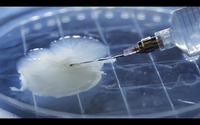
Scientists at the Fraunhofer Institute have developed a new way to 3D print bioscaffolds. Scaffolds are three dimensional structures on which organic material (cells) may grow into properly formed tissue structures. Typically the scaffold then dissolves, leaving the newly formed tissue. The new process involves hitting a liquid concoction mixture of polymers and proteins with a microchip laser pulse - but one only picoseconds in duration. The extremely short pulse is sufficient to cause reactions that solidify the liquid, but not long enough to damage any of the biomaterial. This technique permits 3D printing of biostructures with a resolution of as little as a micrometer! 
 
The researchers hope to use the technology produce tiny cells scaffolds that will enable close study of cell growth patterns in three dimensions, which is not entirely understood. 
 
Image credit: Fraunhofer Institute for Laser Technology ILT
Saturday
Jul232011

BioPrinting: Organovo Strikes Agreements

Organovo, the bioprinting startup that hopes to eventually print whole replacement human organs, has struck agreements with two pharma companies to assist in drug testing. Organovo will print tiny scaffolds on which human tissue can grow into lifelike shapes. These shapes tend to be better grounds for drug testing, as cells in a simple petri dish tend to behave differently than they do in a human body. Testing efficiency should improve. 
  
Meanwhile, the income generated from these agreements will enable Organovo to maintain operations while they continue to work on their eventual goal of replicating human organs. Evidently Organovo is not yet "in the black", but such is the way of startup companies. 
 
Tuesday
Jun212011

Billions For Organ Printing?

An article in the Washington Post explores the startling proposition of 3D printing human organs. This is an incredibly complex goal, since most 3D printing of today involves rather simplistic models: a shape made of a single consistent material deposited in a uniform manner. Yes, a few advanced commercial 3D printers might be able to print in two different materials, but none (as far as we know) can print the detailed internal microscopic structures one would need if building living organs. 
  
Tissue engineers exploring the idea experiment with a variety of approaches, some involving printing a "starter kit" or scaffolding, onto which deposited cells are encouraged to grow in the correct way to develop the desired organ. Tricky stuff, indeed. Be sure to check out their wonderful interactive "How bioprinting works" sidebar
 
In the Post's article, Organovo co-founder Keith Murphy suggests a project to make an entire, usable human organ, such as a kidney, "would require a massive commitment of people, resources and billions of dollars". No doubt, true. Printing organs is definitely not like printing doorstops or cakes. 
 
We think that progress in different areas of advanced 3D printing will be driven by demand. For organs, there will be a growing and enormous demand in the next decade or two as the bulk of the baby-boom population ages and their interior components begin to fail. A high demand for a complex product will likely ensure dedication of many resources for years to come. 
 
Meanwhile, we foresee somewhat less but still strong demand for food printing, which could arrive earlier than organ printing. 
 
One way or another, 3D printed stuff is going to make its way into you. 
 
Thursday
Jun162011

Human Tissue Material?

Nano-engineers at the University of California in San Diego have developed a new biomaterial that evidently is a very close match for human tissue. This material is not a uniform substance, but is rather a particular geometry that exhibits stretching properties useful for bio-engineering. 
 
The material is produced from a liquid polymer resin using light to solidify the resin into the appropriate material geometry in a manner very similar to how several species of 3D printers operate. 
 
While we believe it will be a very, very long time before personal bioprinters appear, it seems that the technology to do so might be emerging. 
 
Saturday
Mar192011

3D Print with Sand, Pee and Bacteria

We are not making this up. It seems that there is always someone, somewhere trying to 3D print with practically any imaginable material. This time the mix is sand, pee (yes, human urine) and a certain type of bacteria. The premise is actually quite interesting: the bacteria (Sporosarcina Pasteuri) are capable of binding the sand's silicon dioxide particles together by using  a Urease Hydrolysis process. Basically, chemicals in the urine are used by the bacteria to fuse the sand together. 
 
Once this is understood, the rest is straightforward 3D printing engineering: sand is spread in a thin layer, bacteria are injected onto the sand layer in an appropriate pattern (likely with inkjet tech), and the bugs do their work. According to the paper: 
 
The binding strength of the precipitated crystals is highly dependent on the rate of carbonate formation and under suitable conditions it is possible to control the reaction to generate hard binding calcite cement (or Biocement). 
 
The resolution of this approach could be quite good, as it's simply as fine as you can distribute the sand layer. In this case, they've managed to hit "100-500 micron layers". Even better, this approach will not require any support material because lower layers of sand will support new layer builds. We're wondering, however, about the length of time required for "curing"; how long does a bacteria take to do its job? How easy will it be to clean the object of loose sand particles? Can it be washed clean without compromising the structure? 
 
Via Lights
Saturday
Jan302010

The Tyee on 3D Printing

There's a long article introducing 3D printing concepts appearing at The Tyee, a British Columbia-based electronic newsmagazine: "The Replicator, No Longer a Star Trek Dream". The article contains interviews with Neil Gershenfeld, Director of MIT's Center for Bits and Atoms, Adrian Bowyer, inventor of the RepRap, Fab Lab users, a RepRap owner, University of Missouri Professor Dr. Gabor Forgacs, and several educational institutions who use the technology. All of this and videos from TED, Fab Lab, the uPrint, RepRap and Organ printing in one place. Enjoy!
