
Sponsors


Recommended
  • Rule 34
    Rule 34
    by Charles Stross

    Stross delves into a possible future where 3D printers become commonplace - and explores the problems that could result. 

  • Printing in Plastic: Build Your Own 3D Printer (Technology in Action)
    Printing in Plastic: Build Your Own 3D Printer (Technology in Action)
    by James Floyd Kelly, Patrick Hood-Daniel
  • 3Dconnexion SpaceNavigator SE (Standard Edition) 3D Navigation Device USB ( 3DX-700028 )
    3Dconnexion SpaceNavigator SE (Standard Edition) 3D Navigation Device USB ( 3DX-700028 )
    3D Connexion
  • The Homebrew Industrial Revolution: A Low-Overhead Manifesto
    The Homebrew Industrial Revolution: A Low-Overhead Manifesto
    by Kevin A. Carson
  • Mastering Blender
    Mastering Blender
    by Tony Mullen
  • Kindle Wireless Reading Device (6
    Kindle Wireless Reading Device (6" Display, Global Wireless, Latest Generation)
    Amazon.com
  • Blender 3D 2.49 Incredible Machines
    Blender 3D 2.49 Incredible Machines
    by Allan Brito
  • Makers
    Makers
    by Cory Doctorow
  • 3Dconnexion SpacePilot PRO - 3D motion controller - 31 button(s) - wired - USB
    3Dconnexion SpacePilot PRO - 3D motion controller - 31 button(s) - wired - USB
    3D Connexion

Entries in autodesk (5)

Sunday
Nov132011

Autodesk's Two New Things: Catch & Make

With the success of their first web-based design tool, 123D, Autodesk has launched (at least for preview) two new apps, Catch and Make. They're both quite different, but readers will find them both useful. 
 
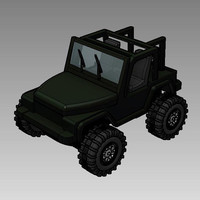
Make is a 3D slicer that converts a 3D model into layers suitable for manual assembly. This is probably best done using a laser cutter or similar device where you cut and fit pieces together to form the object. It has an extremely simple interface from which you may select a basic object such as a car, cube, face, flying saucer, human head, icosahedron, rhino, rocket, shark, skull or torus. You may also upload your own object - it accepts STL format, so you'll be able to load in many of your current 3D models. Once loaded you choose a construction technique, either stacked or interlocked. Then it automatically computes cutout shapes for you to print on your laser cutter. Very easy! 
Catch is quite different. It's an improved version of a 3D model capture process they've been experimenting with for some time. The process involves taking several (ok, many) photographs of an object from multiple angles. These images are then uploaded to Autodesk's bank of mainframes where they somehow convert the images into an actual 3D model. This process is not instant - it takes minutes to complete, but is certainly significantly easier than manually developing a model or buying an expensive 3D scanner. 
 
Strangely, both of these tools have platform constraints. Make is only available on OSX, while Catch works only on MS Windows. We suspect they're working on fixing those constraints. Nevertheless, we think these are both terrific starts on very easy to use 3D tools for those unable to use expensive power 3D software. 
 
Tuesday
Oct112011

Free 123D T-Shirts!

Autodesk is running a promotion to raise interest in their new web-based 3D modeling tool, 123D, which we've written about before
 
You don't get a t-shirt for nothing, though. You have to make an image of your original 3D Jack-o-lantern design and share it within their online gallery. This could be easier than you think if you make use of their starter pumpkin models and instructional video. Then they'll send you a t-shirt. 
 
The program ends (presumably) at the end of this month. 
 
Via 123D
Wednesday
Aug032011

Autodesk Acquires Instructables

3D software giant Autodesk, makers of Maya, Revit, 3DS Max and AutoCAD announced they've acquired Instructables. Instructables provides do-it-yourself instructions for a wide variety of projects, some of which involve 3D printing. Instructables chief Eric J. Wilhelm says: 
 
Autodesk gives us the scale and support to grow and improve Instructables, build some great apps, and continue our mission of creating a positive impact on the world..  Autodesk is a great cultural fit for Instructables.  They make tools for creative people:  they’re the world leader in 3D design, engineering, and entertainment software. 
 
We suspect that's the key element here: Autodesk provides products for creative people and Instructables is a place where you'll find lots of them. Probably a good strategic move by Autodesk - but will this have any effect on the Maker movement? We suspect not so much; Instructables will continue doing their thing, now backed by Autodesk. 
 
Saturday
Aug212010

Wujec on 3D Printing 

Tom Wujec, Fellow at AutoDesk, spoke at the Thinking Digital event earlier this year. In a video of his fascinating talk, Tom speaks of the nature of emerging technologies, specifically tech evolution and tech possibilities.
 
He describes a special moment in the evolution of technology where the previously "impossible", suddenly becomes possible. This is the "sweet spot" where investment recognizes the opportunity and companies actually bring the concept to life. However, he says, timing is always critical. A product too early may fail, even if it's a great idea (Newton? Google Wave?)
 
He reviews several key technology concepts, including Computation, Analog to Digital, Digital to Analog, User Interaction/Augmented Reality, Mobile and Bioinformatics, most of which focus on the notion of a digital representation of actual objects. The one most interesting to us is Digital to Analog, where digital models are transformed into physical objects.
 
He describes a class of objects that are not producible by any other means, including an "insane" model made by one of his clients: a running shoe made from four different materials, including rubber, cloth, etc. The really interesting part was derived from a spiderweb inspiration: an intricate series of thin strands wove over the shoe. Evidently this was printed by a complex six-axis device that extruded the strands and then carefully tied the strings together in 3D! 
 
Tom believes this type of technology could transform the shoe (and other) industries into a manufacturing-by-one model. For example, scan your feet, then select a design and await the printout. However, the shoe lasts "only about ten minutes" as it's made of very fragile stuff.
 
He also describes a concrete printer able to print buildings and bioprinters, capable of printing various replacement body parts. We've written of these concepts before many times, but it's still quite amazing to think about.
 
is 3D printing ahead of its time? What happens next? 
 
Via Thinking Digital (Hat tip to Andy)
Thursday
Apr162009

Mudding with Autodesk

 
We're always looking for ways to simplify the process of personal manufacturing, and Autodesk is pioneering a technology that we think might be able to break down some of the barriers.

According to a great blog post at Robinz CAD Blog, we're seeing the results of Autodesk's 2007 acquisition of SkyMatter, as Autodesk recently exhibited their "Mudbox" interface.


The Mudbox was demonstrated on a rather gigantic touch screen (we'd like to see the shipping crate for that one), but we suspect the technology would function on lesser touchscreens as well. By using multitouch gestures, Mudbox permits designers to shape their objects merely by twisting and dragging in a manner that is reminiscent of clay modeling, not 21st Century CAD. Be sure to watch the video to see how it really works.

We think that an interface like this could lower barriers for entry into the design space for many people. And more designers means more demand for software and devices, which should in theory lower prices, thus increasing demand, and so on. Best of all, it should increases the flow of creative objects.

One more thing: Has Apple seen this interface?

Via Robinz CAD Blog

Reblog this post [with Zemanta]
