Sponsors


Recommended
  • Rule 34
    Rule 34
    by Charles Stross

    Stross delves into a possible future where 3D printers become commonplace - and explores the problems that could result. 

  • Printing in Plastic: Build Your Own 3D Printer (Technology in Action)
    Printing in Plastic: Build Your Own 3D Printer (Technology in Action)
    by James Floyd Kelly, Patrick Hood-Daniel
  • 3Dconnexion SpaceNavigator SE (Standard Edition) 3D Navigation Device USB ( 3DX-700028 )
    3Dconnexion SpaceNavigator SE (Standard Edition) 3D Navigation Device USB ( 3DX-700028 )
    3D Connexion
  • The Homebrew Industrial Revolution: A Low-Overhead Manifesto
    The Homebrew Industrial Revolution: A Low-Overhead Manifesto
    by Kevin A. Carson
  • Mastering Blender
    Mastering Blender
    by Tony Mullen
  • Kindle Wireless Reading Device (6
    Kindle Wireless Reading Device (6" Display, Global Wireless, Latest Generation)
    Amazon.com
  • Blender 3D 2.49 Incredible Machines
    Blender 3D 2.49 Incredible Machines
    by Allan Brito
  • Makers
    Makers
    by Cory Doctorow
  • 3Dconnexion SpacePilot PRO - 3D motion controller - 31 button(s) - wired - USB
    3Dconnexion SpacePilot PRO - 3D motion controller - 31 button(s) - wired - USB
    3D Connexion

Entries in animation (4)

Wednesday
Feb082012

We Built About 8,000 Mouths

Did you catch the movie Coraline? If you did you might have noticed that much of the movie was not made using conventional computer graphics. Instead the producers 3D printed billions (well maybe not quite that much, but a Whole Bunch) of character parts that were then used in Stop-Motion filming. The movie was a huge success. Apparently the approach was deemed sufficiently successful for another movie: The Pirates! Band of Misfits". 
 
The movie's animators had to design and print 3D shapes for all the parts of the characters - in all possible positions. Arms, legs, hands and especially faces. Facial expressions are a huge element in any movie and this is no different. The animators had to create facial parts that could be combined and sequenced to represent emotions and speaking dialogue. Evidently they used a phonetic method to create all required mouth shapes. According to animator Ian Whitlock: 
 
We built about 8,000 mouths. For the Pirate Captain model, we made 257 separate mouths. For someone like Charles Darwin, we probably had about 130 mouths.
 
We'd love to see how they organize mouth storage: "Smile", "Sneer", "Pucker", etc. 
 
Friday
Jan202012

3D Print Animated Beings!

It's fun printing 3D objects with a 3D printer, but typically the problem is they are fixed, unmoving static objects that sit patiently on your desk. What if you could print objects that literally come alive and move around? What if you printed tiny beings that could walk? 
 
Sounds ridiculous, we know. But it's almost true. Just watch the video above and you'll be blown away by what's been made. 
 
What is it, exactly? It's a 3D physical Zoetrope, a device invented almost two centuries ago that, according to Wikipedia, "produces an illusion of action from a rapid succession of static pictures". Light is flashed on pictures in sequence and your eye (and brain) transforms these still images into motion. 
 
The 3D printed Zoetrope does exactly the same thing, except that instead of flat 2D images being illuminated we have have 3D objects illuminated. And your eye changes strobed views of the objects into motion, just like a 2D Zoetrope would do. The results are beyond stunning. It's as if those little fellows are alive. 
 
How can you see this yourself? Simply go to Shapeways and purchase the 3D printed Zoetrope wheel (currently priced at USD$65.19) and then spin it with a strobe light that flashes in sync with the rotation as pictured above. Then you'll see the magic. 
  
http://www.youtube.com/watch?&v=LVa_WwBFtA4
Sunday
Mar072010

Will 3D Printing Win an Academy Award?

It's entirely possible! Two 2009 films nominated made extensive use of 3D printing in their productions: Avatar, nominated for Best Picture of the Year among others, and Coraline, nominated for Best Animated Feature Film. 
 
James Cameron, the man behind Avatar used 3D printing to produce figurines with which lighting tests were performed for "every shot in the movie". The figurines were produced by Legacy Effects.
 
LAIKA productions created thousands of objects used for extensive stop-motion animation in the movie Coraline. One of the fascinating outcomes was a system to create different facial expressions: 208,000 were possible. 
 
Both projects made use of Objet 3D printers
 
Good luck to both films in tonight's show. 
Friday
Feb052010

Animation with 3D Printing

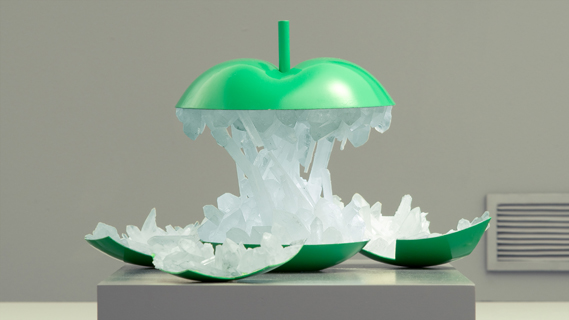
It has been done before, with Coraline, but now a post from Creative Review walks us through how the title sequence for Dutch TV programme "Het Klokhuis" ("The Apple Core") was created.

 The process involved printing numerous objects corresponding to frames of the sequence, which were then placed on a mini-stage and recorded. Animation was accomplished not only through traditional stop-motion techniques, but also through the use of ingenious and tiny motors.

The resulting video is pretty amazing!

Via Creative Review