
Subscribe


Subscribe by Email. Enter address:

Search

Powered by Squarespace
Sponsors

Recommended
  • Fabricated: The New World of 3D Printing
    Fabricated: The New World of 3D Printing
    by Hod Lipson, Melba Kurman
  • Getting Started with MakerBot
    Getting Started with MakerBot
    by Bre Pettis, Anna Kaziunas France, Jay Shergill
  • Bend, Not Break
    Bend, Not Break
    Portfolio
  • Makers: The New Industrial Revolution
    Makers: The New Industrial Revolution
    by Chris Anderson
  • Makers
    Makers
    by Cory Doctorow
  • 3Dconnexion SpaceNavigator SE (Standard Edition) 3D Navigation Device USB ( 3DX-700028 )
    3Dconnexion SpaceNavigator SE (Standard Edition) 3D Navigation Device USB ( 3DX-700028 )
    3D Connexion
  • Printing in Plastic: Build Your Own 3D Printer (Technology in Action)
    Printing in Plastic: Build Your Own 3D Printer (Technology in Action)
    by James Floyd Kelly, Patrick Hood-Daniel
  • The Homebrew Industrial Revolution: A Low-Overhead Manifesto
    The Homebrew Industrial Revolution: A Low-Overhead Manifesto
    by Kevin A. Carson
« The Mysterious Pirate3D Printer | Main | An Interview With Neri Oxman »
Tuesday
Feb262013

A Whale of a 3D Print

It was near the end of a South American expedition for Smithsonian Natural History Museum's Nicholas D. Pyenson, when he learned fossil whales had been uncovered nearby. 
 
Examining the fossils, which had been uncovered by a road crew constructing a new highway across the Atacama Desert, Pyenson discovered the fossils were of a dozen 7 million year old whales.
 
As you might imagine, Pyenson, the Smithsonian's Curator of Fossil Marine Mammals, knew precisely what to do: he called in the SWAT team. In this case, the SWAT team was the Smithsonian's 3D digitization team, who quickly arrived onsite with laser scanners. They successfully captured a number of excellent whale models. 
 
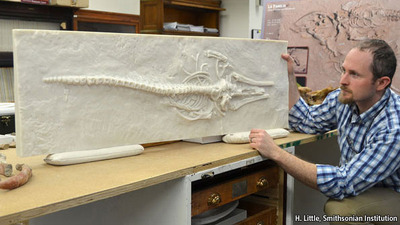
Now what would you do with whale scans? Print them, of course! The team now expects to 3D print life-sized versions of the fossils for display at the venerable institution. Evidently the printing cost for this operation would normally be around USD$1M, but thanks to industry partnerships the Smithsonian can avoid that expense. 
 
And you'll be able to see the whales without having to visit the Atacama Desert. 
 
Via The Economist and Central Science (Hat tip to Chris)
