
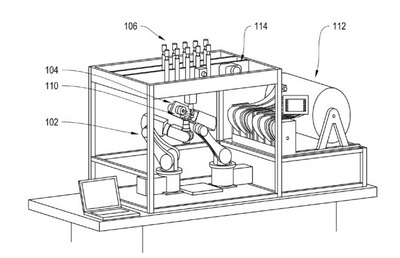
A very detailed patent was recently issued to iRobot and Raytheon for a “Robot Fabricator”.
iRobot is well-known for their Roomba series of household cleaning ‘bots, but they’re also manufacturers of many commercial and military robots. Raytheon is a long-time high-tech industrial focusing on military and electronics markets. Together they bring a huge amount of expertise to the table and could easily produce a capable Robot Fabricator.
The patented system is a “fabrication machine/method that fuses additive and subtractive manufacturing with in-situ component placement to provide completely autonomous all-in-one product manufacturing”. The system focuses around a six-axis robot arm that apparently can take on various tool heads, including those capable of 3D printing.

The robot arm approach is different from traditional 3D printing, which relies on the 3-axis rail approach. Robot arms are more expensive, but are much more versatile. Perhaps cost matters less if you manufacture robots?
We see a couple of interesting points in this patent:
- iRobot and Raytheon are likely targeting the industrial market, not the consumer market. However, their move may lead to improvements in future consumer offerings.
- The patented system should be highly capable. It will also be expensive.
- Combining additive and subtractive manufacturing in a single unit seems to be unique – and probably will require some hefty software to drive it.
- 3D printing continues its advance as more companies get involved.
Via USPTO
