
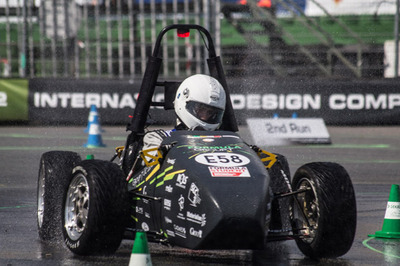
 While it isn’t the world’s first 3D printed car, it may be the first 3D printed Racing Car. The Areion was designed by 16 engineers from “Group T” as their entry in the Formula Student 2012 Challenge.
 Obviously, the entire car was not 3D printed – only the body, which was then attached to a conventional chassis, engine and other parts. Unlike the Urbee 3D printed car, whose body is composed of a dozen or so 3D printed parts, the Aerion’s body appears to be a single piece.
But wait! A car body is a rather large item to 3D print. How big of a 3D printer is necessary?
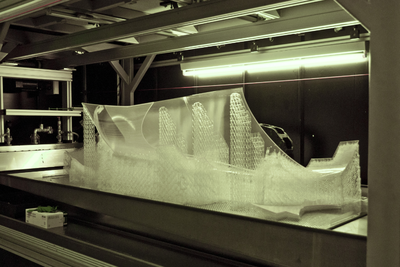 The body was produced at Materialise on their “Mammoth” stereolithography machine, which has a build envelope of an astonishing 2.1m x 0.68m x 0.8m. Yes, that’s “m” for meters.
 This approach vastly simplifies the construction of the vehicle, in addition to reducing weight, because various fittings can be directly integrated into the body 3D model without requiring additional parts to be attached.
Via Materialise
