

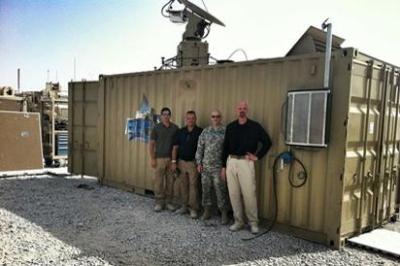
 In Afghanistan the US Army has deployed the first of several USD$2.8M mobile prototyping labs. These container-sized labs house 3D printers and CNC machines capable of rapidly producing spare or replacement parts that would otherwise take months to order and be delivered using conventional approaches.
 The Army has a special unit known as the “Rapid Equipping Force”, who, according to Wikipedia, is:
charged with providing Army units deployed globally with specialized and specific capabilities (materiel) quickly in order to affect the outcome of wars and battles.
Evidently one of their goals is to speed the delivery of necessary equipment. Making parts in real time on site would definitely assist meeting that goal.
Another problem solved by this approach is the mangling of requirements as requests travel traditional processes. Did the soldiers really receive what they actually wanted? Now they simply make it themselves and bypass any potential issues. Actually, soldiers would work with two engineers that come with the lab, and even more expertise available through the network.
We’re not certain what type of 3D printing equipment might be present in these mobile labs; perhaps it’s a secret. We speculate it is likely Stratasys equipment that is known for producing strong parts suitable for production use.
One of the most interesting aspects of this development is that soldiers can now request new designs that have not previously existed to address specific battlefield situations. 3DP-enabled soldiers!
Via Military.com

I can confirm the U.S. military uses Stratasys printers. Good guess!
Just last week I toured the Stratasys Redeye factory, and one of the things the tour guide mentioned was that the Navy uses Stratasys machines to make mold for bending sheet metal – yes plastic forms to bend metal!
The example he gave was if a 'copter comes back with say a hole in the side and a damaged interior rib, they'll 3D print a male and female die to sandwich the metal between. The plastic has to be about 2-4 inches thick to withstand the hydraulic press pressure, but it really works!
I can imagine this is useful when on the battlefield far away from the manufacturer's factory parts!
Sounds like the best job in the army would be an engineer at one of those proto labs. That's pretty awesome.