
Subscribe


Subscribe by Email. Enter address:

Search

Powered by Squarespace
Sponsors

Recommended
  • Fabricated: The New World of 3D Printing
    Fabricated: The New World of 3D Printing
    by Hod Lipson, Melba Kurman
  • Getting Started with MakerBot
    Getting Started with MakerBot
    by Bre Pettis, Anna Kaziunas France, Jay Shergill
  • Bend, Not Break
    Bend, Not Break
    Portfolio
  • Makers: The New Industrial Revolution
    Makers: The New Industrial Revolution
    by Chris Anderson
  • Makers
    Makers
    by Cory Doctorow
  • 3Dconnexion SpaceNavigator SE (Standard Edition) 3D Navigation Device USB ( 3DX-700028 )
    3Dconnexion SpaceNavigator SE (Standard Edition) 3D Navigation Device USB ( 3DX-700028 )
    3D Connexion
  • Printing in Plastic: Build Your Own 3D Printer (Technology in Action)
    Printing in Plastic: Build Your Own 3D Printer (Technology in Action)
    by James Floyd Kelly, Patrick Hood-Daniel
  • The Homebrew Industrial Revolution: A Low-Overhead Manifesto
    The Homebrew Industrial Revolution: A Low-Overhead Manifesto
    by Kevin A. Carson
« 3D Printing Is Now Popular, It's True! | Main | How Will 3DP Affect Your City? »
Friday
Jun152012

Hot Glue Gun Extruder 3DP Experiment

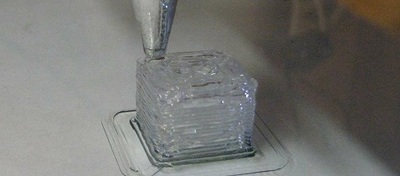
Another 3D printing experiment appeared on Hack A Day, in which a common workshop hot glue gun was persuaded to act as an extruder for a hobby 3D printer. 
 
At first this might make sense, as the hot glue gun does extrude material that solidifies. However, after watching the video and thinking about it, we believe this is probably not a terrific way to extrude. While it might be less expensive to make, there are issues: 
 
  • The extruded "glue" seems to slump considerably, meaning rough surfaces and likely difficulties in printing even slight overhangs
  • The glue feeder is limited in capacity to the size of standard glue sticks. Ok for small prints, but anything large would be tricky, unless you build an "auto-feeder"
  • It's really slow. Large prints would take a very long time to complete
 
But now we know, thanks to an idea and an experiment.
