
 There are quite a few different approaches to producing 3D objects using additive manufacturing (as opposed to subtractive manufacturing; you know, carving and chopping), but MIT’s latest idea is perhaps the most advanced we’ve yet seen.
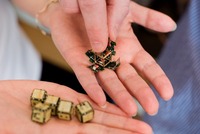
 While most 3D printers either deposit or fuse in-place material into solid objects, MIT’s experiment involves a massive vat of “smart sand”. These are microscopic computer controlled objects that in theory would be able to self-assemble into desired 3D shapes.
One scenario for using them might be to insert an existing object into a vat of the “smart sand” and wait for the “grains” to recognize the foreign shape. They’d then self-assemble into an identical form. It resembles a science fiction “object copier”.
How is this really accomplished? By inventing incredibly smart and efficient software algorithms to control the movements and magnetic attachment points of the grains. The grains would communicate to each other using short-range networks to coordinate their activities.
While this is a truly 21st century innovation, we’re contemplating the implications. If this approach could be made tiny enough, made objects would have incredibly smooth and accurate surfaces. We’re also wondering about the strength of such an object – would magnets be sufficient to use the object in an engine, for example? Could one have a “sand kit” for road repairs? Recycling would be a trivial matter – but you’d better not have any magnets nearby, or else chaos will result.
This is one technology to watch.
Via MIT

I think you're missing the point somewhat. When you scale down the parts to, say, molecule size, you wouldn't be talking about eletronics and magnets any more. But more an organic form of connecting building blocks, exactly like molecules would do. And on that scale forces required are tiny.
I think you're missing the point somewhat. When you scale down the parts to, say, molecule size, you wouldn't be talking about eletronics and magnets any more. But more an organic form of connecting building blocks, exactly like molecules would do. And on that scale forces required are tiny.
Think "Super 8" movie…..
Think "Super 8" movie…..