
Subscribe


Subscribe by Email. Enter address:

Search

Powered by Squarespace
Sponsors

Recommended
  • Fabricated: The New World of 3D Printing
    Fabricated: The New World of 3D Printing
    by Hod Lipson, Melba Kurman
  • Getting Started with MakerBot
    Getting Started with MakerBot
    by Bre Pettis, Anna Kaziunas France, Jay Shergill
  • Bend, Not Break
    Bend, Not Break
    Portfolio
  • Makers: The New Industrial Revolution
    Makers: The New Industrial Revolution
    by Chris Anderson
  • Makers
    Makers
    by Cory Doctorow
  • 3Dconnexion SpaceNavigator SE (Standard Edition) 3D Navigation Device USB ( 3DX-700028 )
    3Dconnexion SpaceNavigator SE (Standard Edition) 3D Navigation Device USB ( 3DX-700028 )
    3D Connexion
  • Printing in Plastic: Build Your Own 3D Printer (Technology in Action)
    Printing in Plastic: Build Your Own 3D Printer (Technology in Action)
    by James Floyd Kelly, Patrick Hood-Daniel
  • The Homebrew Industrial Revolution: A Low-Overhead Manifesto
    The Homebrew Industrial Revolution: A Low-Overhead Manifesto
    by Kevin A. Carson
« A Swiss 3D Printer Seller | Main | High Detailed Stainless Steel Prints at i.Materialise »
Saturday
Oct202012

MCOR Rolls Out the Matrix 300+

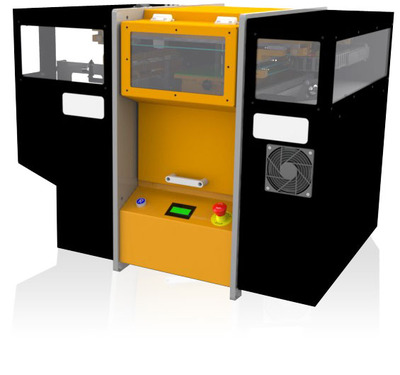
MCOR announced their new Matrix 300+ paper-based 3D printer. This device is similar to the 300, but offers improved performance in how the models are constructed. 
 
They've included a new feature called "Selectable Layer Thickness", in which you could print in either "Draft" or "Presentation". We suspect what might be happening here is that instead of a single sheet of paper per layer, Draft mode would use multiple sheets per layer. This would make printing substantially faster, but produce less detailed prints. 
 
MCOR has also included something called "Variable Volume Deposition", which "enables the production of more complex parts that are even stronger and more durable." We're not exactly sure what this means, but it could be a different method of structuring layers for parts with complex geometries. 
 
Via MCOR
