
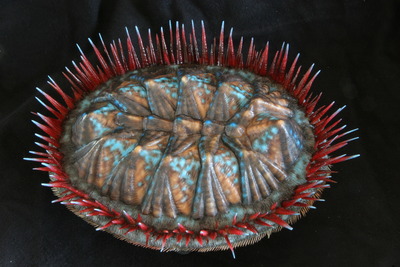
 3D printing is an amazing process, not only to simply watch a print appear from thin air, but also for the things it makes possible. We’re reading how a species of mollusk, the multiplacophoran Protobalanus spinicoronatus, extinct for 390 million years has been re-created using 3D printing.
 Researchers at the Jackson School of Geosciences at the University of Texas used a hybrid of conventional model-building techniques with 21st century 3D scanning and printing to produce the lifelike model of the Protobalanus spinicoronatus.
The process involved detailed micro CT 3D scans of fossilized Protobalanus spinicoronatus remains and gradually creating a usable 3D model of the specimen. This must have been quite difficult, as the fossilized remains do appear quite different from the eventual model, particularly in the positioning of the pointy bits.
The final model was made from a combination of clay, resin and silicone, which, to the best of our knowledge, shows the actual visual appearance of the creature.
But is “de-extincting” a valid word?
