
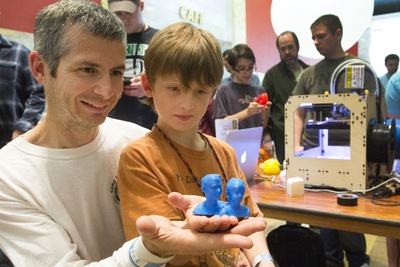
 Computer engineer Jeremy Herrman has developed an amazing software configuration that dramatically simplifies the process of scanning humans. Or anything, really. It’s the software you need to set up a kind of 3D Photo Booth, called ScanBooth.
 Readers who have attempted scans of people with open source gear will know very well the issues involved. Beyond getting the excited subject to sit still during the scan, much work must be done to prepare the rough scan for 3D printing. The scanned mesh is typically full of holes, has awful scar-like seams and other issues. Up to an hour of repair work using a variety of software tools is required to produce a 3D printable model.
But that’s no more. ScanBooth attempts to automate this workflow by taking the raw scan and running it through a series of transformations to produce a usable 3D model. Herrman says the workflow is reduced to approximately eight minutes.
The software is provided free of charge at GitHub, but you must install all the components and thus require a bit of software knowledge to do so.
This will be a huge aid to hobbyists and makerspaces worldwide, but it does demonstrate that the current set of software available for 3D printing is deficient. We believe that while 3D printing hardware has advanced significantly, the associated software lags.
