
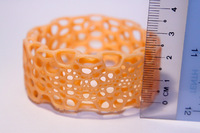
 We’re perusing Junior Veloso’s blog – he’s the fellow who’s developing a very high-resolution personal 3D printer. The device is quite different from most home RepRap-derived 3D printers in that it doesn’t heat and extrude plastic. Instead, Veloso’s printer uses light to solidify resin, layer by layer. The results are pretty amazing – click the image to see the full size close-up image.
 This approach has several advantages:
- Each layer can be created all at once, as opposed to extrusion-based printers that must mechanically trace all print areas. This makes the print process run quickly
- The resolution can be much higher because it’s limited by the focal ability of the light projector and the resin’s speed of solidification rather than the mechanical movements of an extruder
But there may be some disadvantages as well:
- The cost of the resin is said to be high, but may drop when demand increases
- “Wet” printing can be messier than “dry” extrusion, where there’s nothing to spill or drip
Veloso indicates he’s interested in developing this concept into a mostly open source concept, with some him providing certain key components. He’s attempting to procure a patent that should protect him from lawsuits – if his approach has not already been patented by an existing manufacturer.
We’re wondering how this may play out. If we look at the example of RepRap, their technology breakthroughs spurred the development of many inexpensive 3D printer companies, some of which are growing fast. But could Veloso’s concept share the same result? Could we see several companies built on his tech in the future? If they can produce output like we’re seeing that could be a good thing.
Via 3Dhomemade

Very much presentative and a require a deep thinking to understand the photo concept.
Very much presentative and a require a deep thinking to understand the photo concept.
He can't patent that process; it's been in use for over a decade. I am speaking about object platform rising out of the resin bath as a UV ligh catalyzes it layer by layer. None of these technologies are new – additive extrusions, UV/resin, etc… The only thing new is the low cost of technology and the masses finally getting it into their hands.
Rob
He can't patent that process; it's been in use for over a decade. I am speaking about object platform rising out of the resin bath as a UV ligh catalyzes it layer by layer. None of these technologies are new – additive extrusions, UV/resin, etc… The only thing new is the low cost of technology and the masses finally getting it into their hands.
Rob