
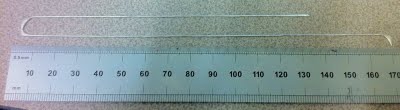
 The RepRap team continue to develop methods of printing electrical conductors. If they succeed, it would be possible for future 3D printers to print objects that include (at least at first) simple electronic circuits embedded directly in their shapes. One can imagine a wide variety of LED lamps or switchboxes emerging quickly once this tech is available, for example.
But is it available? Rhys Jones described RepRap’s recent experiments in a long post detailing the steps they’ve taken. While the mechanics of 3D printing electronics would be mostly identical to printing in plastic or food, the extruder and material are what’s really different.
They’ve been testing electrically conductive materials with these characteristics:
- Reasonable melting point, similar to the plastic currently used in 3D printers
- Significant viscosity to enable extrusion
- Low surface tension effect to ensure accurate deposition during printing
But problems emerged, mainly that their metal extruder (brass) slowly dissolved in the molten metal material and new approaches had to be developed. Eventually they used a hi-temp PTFE nozzle liner and a low-melt point alloy of 57.5% Tin, 41.3% Bismuth, 1.2% Indium that successfully achieved printing the conductive traces above.
This is by no means a ready-to-use technology; They’re still working on it, and there is also the question of sourcing this peculiar mix of metals in printable filament. However, this is how all new technology appears, and if it works, we may see it on your desktop sometime in the future.
Via RepRap
