
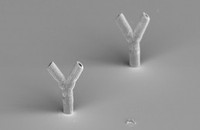
 Scientists at the Fraunhofer Institute have developed a new way to 3D print bioscaffolds. Scaffolds are three dimensional structures on which organic material (cells) may grow into properly formed tissue structures. Typically the scaffold then dissolves, leaving the newly formed tissue. The new process involves hitting a liquid concoction mixture of polymers and proteins with a microchip laser pulse – but one only picoseconds in duration. The extremely short pulse is sufficient to cause reactions that solidify the liquid, but not long enough to damage any of the biomaterial. This technique permits 3D printing of biostructures with a resolution of as little as a micrometer!
 The researchers hope to use the technology produce tiny cells scaffolds that will enable close study of cell growth patterns in three dimensions, which is not entirely understood.
Via Kurzweil and Fraunhofer ILT
Image credit: Fraunhofer Institute for Laser Technology ILT
