
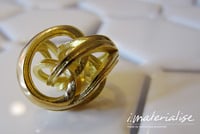
 3D print service i.Materialise now offers printing in Gold and Silver metals. They’re not the first service to offer this ability, but it’s wonderful to see another golden service.
 Specifics: In addition to the sterling silver, there are three colors of 14 kt gold offered, bright yellow, reddish tinge and white gold available. Prints can be made with up to 0.3mm resolution. The maximum size of these prints is only 88x63x125mm – but if it wasn’t limited by size, it would be limited by your pocketbook, as printing in gold and silver is quite expensive.
There’s one catch: the i.Materialise print farm doesn’t actually print gold and silver directly. Instead, they print a wax model of your design first, and then they use the “lost wax casting” method to produce an actual metal object made of solid gold (or silver). Finally, they finish it off with a lot of hand polishing, which should take out any lines from the 0.3mm resolution printing.
Actually, there are two catches. The second is that the lost wax casting method cannot be used on arbitrary shapes. Any embedded or looped objects just won’t work. i.Materialise says, for example, that the “ball within a ball” or “chain links” are forbidden. Polishing also requires the ability to reach all surfaces. A detailed design guide describes all these nuances in detail for designers.
We foresee a great deal of imaginative jewelry appearing now that there are good gold/silver 3D printing options available to designers.
Via i.Materialise

Wouldn't it be better to do the post processing on the wax model for as much as posible? That way you minimize loss of expensive material on polishing, and in case of a total screw up, lose as little done work as possible.
Small mistake in your post, the layer thickness (z-resolution) is 0.033mm, x-y resolution is 0.039mm. The minimum detail is 0.3mm. Otherwise it would be way too coarse for making jewellery.