
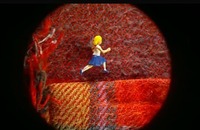
 Nokia Cellscope: a very simple combination of a Nokia phone and a microscope, capable of seeing very small things at low cost. The idea is to enable those in third world countries to perform basic microscopy – and then instantly transmit results for expert analysis elsewhere.
  To celebrate the development of the Cellscope, Nokia engaged Aardman to produce the “world’s smallest stop motion video” using the Cellscope itself. Aardman’s problem was making the very tiny stop motion characters, and they turned to UK-based IPF to produce the extremely tiny figurines that appear in the video. As you can see above, the figurines are incredibly small, only 9mm tall. Some fifty were made for the shoot.
 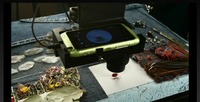 Two dimensional designs were converted into 3D models, which were then printed on IPF’s 3D printers. As you’ll see in the video, painting these figurines was a very careful process. And that’s not all: the tedious stop-motion process yielded only four seconds of video each day.