
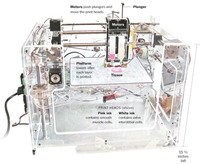
 An article in the Washington Post explores the startling proposition of 3D printing human organs. This is an incredibly complex goal, since most 3D printing of today involves rather simplistic models: a shape made of a single consistent material deposited in a uniform manner. Yes, a few advanced commercial 3D printers might be able to print in two different materials, but none (as far as we know) can print the detailed internal microscopic structures one would need if building living organs.
 Tissue engineers exploring the idea experiment with a variety of approaches, some involving printing a “starter kit” or scaffolding, onto which deposited cells are encouraged to grow in the correct way to develop the desired organ. Tricky stuff, indeed. Be sure to check out their wonderful interactive “How bioprinting works” sidebar.
In the Post’s article, Organovo co-founder Keith Murphy suggests a project to make an entire, usable human organ, such as a kidney, “would require a massive commitment of people, resources and billions of dollars”. No doubt, true. Printing organs is definitely not like printing doorstops or cakes.
We think that progress in different areas of advanced 3D printing will be driven by demand. For organs, there will be a growing and enormous demand in the next decade or two as the bulk of the baby-boom population ages and their interior components begin to fail. A high demand for a complex product will likely ensure dedication of many resources for years to come.
Meanwhile, we foresee somewhat less but still strong demand for food printing, which could arrive earlier than organ printing.
One way or another, 3D printed stuff is going to make its way into you.
Via Washington Post
