
 You may have seen a freight train pass by hauling endless standard-sized shipping containers. Those containers make freight economical because the entire transportation system can safely assume their characteristics and adapt appropriately.
 There’s a similar standard for space satellites: CubeSat. It’s a one-liter 10 x 10 x 10 cm cube that can weigh no more than 1.33Kg. CubeSats are typically used by academics to prepare scientific payloads for use in space. Launch vehicles are able to accommodate the CubeSats because they all have the same physical standards.
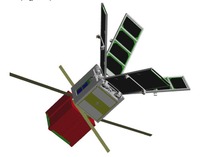
Now we see a team has developed a CubeSat using 3D printing. A team including people from Project Starshine, Planetary Systems Corporation, The University of Arkansas, Colorado Satellite Services, Morehead State University, Montana State University, Air Force Research Laboratory/Space Vehicles Directorate, CRP USA, LLC;, Analytical Graphics, Inc., United States Air Force, Universal Space Network and Space Dynamics Laboratory CRP built a 2U (two units) CubeSat to investigate the inner Van Allen radiation belt. Their satellite, called “RAMPART” (RApid prototyped Mems Propulsion And Radiation Test CUBEflow SATellite) measures particle flux and other dangerous stuff high in the sky.
 Needless to say, in such an endeavor equipment will face significant thermal, chemical and mechanical stress. They also needed to design a CubeSat with as low mass as possible. To meet these challenges, one of the key technologies used was a special material developed by CRP called Windform XT, a polyamide-based material. 3D printing was done using powder-based laser sintering. The final CubeSat was plated with High Phosphorus Electroless Nickel, apparently to provide a target for radar tracking.
 This shows the potential for 3D printing when different materials are specifically designed for a unique purpose. One can imagine this and other powerful materials available for use by 3D printers, enabling a much wider set of possible printable objects.
Via Additive3D and WindForm
