
Sponsors

Recommended
  • Rule 34
    Rule 34
    by Charles Stross

    Stross delves into a possible future where 3D printers become commonplace - and explores the problems that could result. 

  • Printing in Plastic: Build Your Own 3D Printer (Technology in Action)
    Printing in Plastic: Build Your Own 3D Printer (Technology in Action)
    by James Floyd Kelly, Patrick Hood-Daniel
  • 3Dconnexion SpaceNavigator SE (Standard Edition) 3D Navigation Device USB ( 3DX-700028 )
    3Dconnexion SpaceNavigator SE (Standard Edition) 3D Navigation Device USB ( 3DX-700028 )
    3D Connexion
  • The Homebrew Industrial Revolution: A Low-Overhead Manifesto
    The Homebrew Industrial Revolution: A Low-Overhead Manifesto
    by Kevin A. Carson
  • Mastering Blender
    Mastering Blender
    by Tony Mullen
  • Kindle Wireless Reading Device (6
    Kindle Wireless Reading Device (6" Display, Global Wireless, Latest Generation)
    Amazon.com
  • Blender 3D 2.49 Incredible Machines
    Blender 3D 2.49 Incredible Machines
    by Allan Brito
  • Makers
    Makers
    by Cory Doctorow
  • 3Dconnexion SpacePilot PRO - 3D motion controller - 31 button(s) - wired - USB
    3Dconnexion SpacePilot PRO - 3D motion controller - 31 button(s) - wired - USB
    3D Connexion
« 3D Printed Curvilinear Antennae | Main | A Look Inside the V-Flash »
Thursday
Mar242011

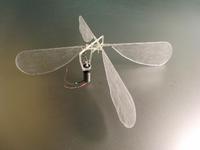
3D Printed Ornithopter Wings

Researchers at the Cornell Computational Synthesis Laboratory building a miniature ornithopter (that's a flying device that uses flapping wing motions for lift) had a problem: the wings were difficult to create due to their small size and mechanical requirements.  
 
The problem was solved by using 3D printing techniques to create the wings. The 3D printing approach also was substantially faster than previous methods: "reduced the time of a wing design cycle to a matter of minutes".
 
According to their paper's abstract:
 
An ornithopter with a mass of 3.89g has been constructed using the 3D printing technique and has demonstrated an 85-second passively stable untethered hovering flight. This flight exhibits the functional utility of printed materials for flapping wing experimentation and ornithopter construction and for understanding the mechanical principles underlying insect flight and control.
 

Reader Comments

There are no comments for this journal entry. To create a new comment, use the form below.

PostPost a New Comment

Enter your information below to add a new comment.

My response is on my own website »
Author Email (optional):
Author URL (optional):
Post:
 
Some HTML allowed: <a href="" title=""> <abbr title=""> <acronym title=""> <b> <blockquote cite=""> <code> <em> <i> <strike> <strong>
