
Sponsors

Recommended
  • Rule 34
    Rule 34
    by Charles Stross

    Stross delves into a possible future where 3D printers become commonplace - and explores the problems that could result. 

  • Printing in Plastic: Build Your Own 3D Printer (Technology in Action)
    Printing in Plastic: Build Your Own 3D Printer (Technology in Action)
    by James Floyd Kelly, Patrick Hood-Daniel
  • 3Dconnexion SpaceNavigator SE (Standard Edition) 3D Navigation Device USB ( 3DX-700028 )
    3Dconnexion SpaceNavigator SE (Standard Edition) 3D Navigation Device USB ( 3DX-700028 )
    3D Connexion
  • The Homebrew Industrial Revolution: A Low-Overhead Manifesto
    The Homebrew Industrial Revolution: A Low-Overhead Manifesto
    by Kevin A. Carson
  • Mastering Blender
    Mastering Blender
    by Tony Mullen
  • Kindle Wireless Reading Device (6
    Kindle Wireless Reading Device (6" Display, Global Wireless, Latest Generation)
    Amazon.com
  • Blender 3D 2.49 Incredible Machines
    Blender 3D 2.49 Incredible Machines
    by Allan Brito
  • Makers
    Makers
    by Cory Doctorow
  • 3Dconnexion SpacePilot PRO - 3D motion controller - 31 button(s) - wired - USB
    3Dconnexion SpacePilot PRO - 3D motion controller - 31 button(s) - wired - USB
    3D Connexion
« MCOR Nominated For Award | Main | Dam Building With a 3D Printer »
Saturday
Feb192011

CNN Reports on 3D Printing Human Skin

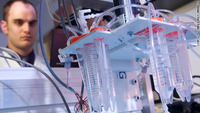
A report today in CNN describes the incredible work being done to assist injured soldiers. While many types of injuries occur overseas, one of the most common is burned skin - evidently 5-20% of all combat injuries. A new initiative attempts to rebuild skin damaged in this way using 3D print technology.
 
The approach is to use a bioprinter adapted from common everyday inkjet technology to deposit various types of living cells in an appropriately shaped 3D array. Where does the feedstock come from? From the patient, of course. A sample is taken ahead of time, then separately cultured into a large quantity. This material then becomes the printable media for the process. The "skin" is printed directly onto the patient, and the cells naturally take hold and fuse together. 
 
Skin is just the start; the researchers believe they can adapt the technique to other types of living tissue, including human organs. We have no doubt of this, as 3D printing technology is incredibly versatile. We wonder whether anyone has considered the possibility of including non-organic material in such prints to provide enhancement beyond normal human abilities? 
 
Via CNN (Hat tip to Linda)

Reader Comments

There are no comments for this journal entry. To create a new comment, use the form below.

PostPost a New Comment

Enter your information below to add a new comment.

My response is on my own website »
Author Email (optional):
Author URL (optional):
Post:
 
Some HTML allowed: <a href="" title=""> <abbr title=""> <acronym title=""> <b> <blockquote cite=""> <code> <em> <i> <strike> <strong>