
Sponsors

Recommended
  • Rule 34
    Rule 34
    by Charles Stross

    Stross delves into a possible future where 3D printers become commonplace - and explores the problems that could result. 

  • Printing in Plastic: Build Your Own 3D Printer (Technology in Action)
    Printing in Plastic: Build Your Own 3D Printer (Technology in Action)
    by James Floyd Kelly, Patrick Hood-Daniel
  • 3Dconnexion SpaceNavigator SE (Standard Edition) 3D Navigation Device USB ( 3DX-700028 )
    3Dconnexion SpaceNavigator SE (Standard Edition) 3D Navigation Device USB ( 3DX-700028 )
    3D Connexion
  • The Homebrew Industrial Revolution: A Low-Overhead Manifesto
    The Homebrew Industrial Revolution: A Low-Overhead Manifesto
    by Kevin A. Carson
  • Mastering Blender
    Mastering Blender
    by Tony Mullen
  • Kindle Wireless Reading Device (6
    Kindle Wireless Reading Device (6" Display, Global Wireless, Latest Generation)
    Amazon.com
  • Blender 3D 2.49 Incredible Machines
    Blender 3D 2.49 Incredible Machines
    by Allan Brito
  • Makers
    Makers
    by Cory Doctorow
  • 3Dconnexion SpacePilot PRO - 3D motion controller - 31 button(s) - wired - USB
    3Dconnexion SpacePilot PRO - 3D motion controller - 31 button(s) - wired - USB
    3D Connexion
« The Economist on 3D Printing | Main | Lexus Invents New Form of 3D Printing »
Monday
Feb142011

Natural 3D Printing

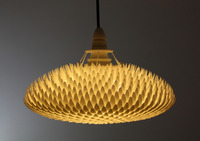
Ponoko posted of a wonderful story about Sydney-based lighting company SandFlora's experience designing a beautiful lamp. The interesting part was the inspiration: nature. In fact, this line of lamp was inspired by the intricate Waratah flower, native to Australia. 
  
The lamp was of course 3D printed and looks amazing. 
 
Our interest, as was Ponoko's, is in the inspiration: nature. While we may find many 3D designs, it seems most of them derive their origin from man-made items such as buildings, parts, jewelry or popular icons. Why isn't there large numbers of beautiful nature models available? 
 
Could it be that natural objects are harder to design? Probably - it's a lot harder to model a delicate leaf than a hockey puck. Perhaps advances in 3D scanning and 3D modelling software may lead to new explorations in natural 3D design. 
 
We think that nature has much to provide us design-wise. There are countless beautiful shapes in existence, evolved over millennia that can inspire new 3D models. 
 
Via Ponoko

Reader Comments

There are no comments for this journal entry. To create a new comment, use the form below.

PostPost a New Comment

Enter your information below to add a new comment.

My response is on my own website »
Author Email (optional):
Author URL (optional):
Post:
 
Some HTML allowed: <a href="" title=""> <abbr title=""> <acronym title=""> <b> <blockquote cite=""> <code> <em> <i> <strike> <strong>