
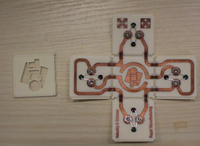
 Ponoko’s CEO David ten Have believes 3D printers will soon be able to print actual working circuit boards, in a recent chat with Wired. According to ten Have, “most of the assembly tools are completely automated anyway”.
 The RepRap project’s design goal is to design a machine that can actually reproduce itself, but automated production of electronics is one of the missing elements in the dream of self-reproductive machines. While the current RepRap design is fully capable of printing most of its own parts, it isn’t able to reproduce a few items, such as the metal elements, motors and the electronics.
There have been many experiments in electronics printing, which involve the extrusion of a material onto a surface to form conductive traces through which the electronic signals may flow. ten Have suggests that more complex components, such as resistors, capacitors and microchips might be mechanically picked and affixed to printed boards. Theoretically this approach could produce usable electronics for reproducible 3D printers, although that’s a little different from what constitutes today’s concept of a 3D printer.
But even if all the parts are successfully reproduced, there’s still one thing left to do: find a way to automatically assemble all these pieces. When that happens, we can leisurely observe machines multiplying. Or start worrying.
