
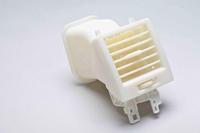
 Objet just announced another amazing material for their Connex and Eden 3D printers. This new material, called “High Temperature Material”, not surprisingly provides 3D prints that can withstand high temperature exposure.
 It can withstand a temperature of +65C (149F) right out of the printer, but if you post-process the object with a “short oven-based, post-thermal treatment” it can withstand a near boiling +80C (176F). Pretty impressive! Objet’s news release went on to say that their company now offers an amazing total of 68 different build materials.
Sixty-eight materials! That got us thinking. Let’s contrast this with the state of personal 3D printing materials: with a few exceptions, you must typically choose three things:
- Material Type: A choice of either ABS or PLA plastic. Occasionally you’ll see a unique support material offered, such as MakerBot’s water soluble PVA.
- Filament Size: Either 3mm or 1.75mm, depending on the extruder your machine uses. So it’s not really a choice.
- Color: We like blue.
So other than color, the choices are already made as they depend on your situation. You need ABS or PLA? Simple, right?
It is for now. But we envision a future where things get more complicated. A world where 3D printers are plentiful and affordable, where gadget shops stock and sell material cartridges for them. What will the supply shelf of the future look like? Today’s ink cartridges typically occupy multiple shelves to merely cover off printer model and the four CMYK colors. The future 3D printer cartridge shelf might be unimaginably complex as it may have to cover not only colors and printer models, but also different materials. If the affordable 3D printers of the future can handle 68 different materials, or even 12, the shelves will be overflowing with options.
Via PRNewsWire
