

 It’s possible to buy a color 3D printer, but they’re currently very expensive, such as those from ZCorp. Meanwhile, typical home 3D printers are monochrome, at least until you change the input plastic filament. The good news is that the selection of filament colors continues to increase and now includes quite a variety beyond simple base colors – even glow-in-the-dark plastic can be had.
 However, how does one change colors in mid-print on an inexpensive 3D printer? One obvious solution is to cut the filament and feed in an alternate color – but this technique is not ideal as you can’t accurately predict when the color coming out the nozzle will actually change and frequent color changes are problematic.
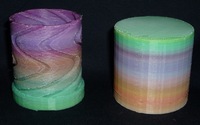 Another simple and effective technique recently involved use of a garden-variety marker pen writing on the input filament as seen in the image. While colors can be changed, this approach also suffers from the “when does it come out?” problem.
 A RepRap experiment last year attempted to use inkjets, but this was really not for coloring solids, but for laying down special substances in small amounts – like electrical traces or sticky parts, etc.
Makerbot hosts a wiki page that investigates the problem of color 3D printing, and the conclusion is that to do it properly, it’s pretty complex. New hardware is clearly required, as well as serious software upgrades. Worse, STL format might have to be changed to account for color information.
Bottom line: Buy some colored markers.
