
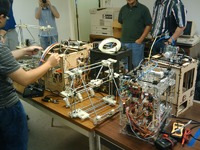
 Members of Kansas City’s Cowtown Computer Congress had an unusual event: 3D Printer Calibration Night. That’s right, members brought in their MakerBot 3D printers in an effort to properly calibrate their heater barrels, which are notoriously tricky to set right.
 Half a dozen MakerBots and a couple of RepRaps appear to be present in the images, where members shared tips on how to get their heater barrel thermocouples properly calibrated.
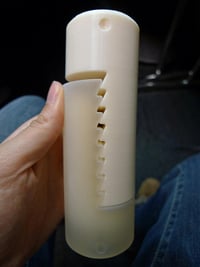 A great exercise, to be sure, but it does suggest an issue in the world of home 3D Printing: standardization. MakerBots, RepRaps and the like certainly have common designs, but there is variability in the components used, configuration parameters and in the manner of assembly. These minor differences result in differences in the resulting printed objects. This suggests that objects printed on one printer may have issues fitting with those from other printers, as shown in the image above.
What’s the answer? We’re not sure, but it probably will involve more standardized components, more assembly-tolerant designs and perhaps even calibration objects specifically to test compatibility between printers.
Image Credit: Nadya Peek

Informative post about the MakerBot. Don't know a whole lot about it but I've read a few interesting articles about how it's supposed to work. Wasn't aware that there were issues with compatibility though 🙁
Informative post about the MakerBot. Don't know a whole lot about it but I've read a few interesting articles about how it's supposed to work. Wasn't aware that there were issues with compatibility though 🙁