
Sponsors


Recommended
  • Rule 34
    Rule 34
    by Charles Stross

    Stross delves into a possible future where 3D printers become commonplace - and explores the problems that could result. 

  • Printing in Plastic: Build Your Own 3D Printer (Technology in Action)
    Printing in Plastic: Build Your Own 3D Printer (Technology in Action)
    by James Floyd Kelly, Patrick Hood-Daniel
  • 3Dconnexion SpaceNavigator SE (Standard Edition) 3D Navigation Device USB ( 3DX-700028 )
    3Dconnexion SpaceNavigator SE (Standard Edition) 3D Navigation Device USB ( 3DX-700028 )
    3D Connexion
  • The Homebrew Industrial Revolution: A Low-Overhead Manifesto
    The Homebrew Industrial Revolution: A Low-Overhead Manifesto
    by Kevin A. Carson
  • Mastering Blender
    Mastering Blender
    by Tony Mullen
  • Kindle Wireless Reading Device (6
    Kindle Wireless Reading Device (6" Display, Global Wireless, Latest Generation)
    Amazon.com
  • Blender 3D 2.49 Incredible Machines
    Blender 3D 2.49 Incredible Machines
    by Allan Brito
  • Makers
    Makers
    by Cory Doctorow
  • 3Dconnexion SpacePilot PRO - 3D motion controller - 31 button(s) - wired - USB
    3Dconnexion SpacePilot PRO - 3D motion controller - 31 button(s) - wired - USB
    3D Connexion
« World's Fastest Motorcycle: Scanned | Main | Add a Floor for only $129 »
Friday
Jul302010

Home Sintering Experiments

You don't have enough cash on hand to buy that USD$40,000 Laser Sintering unit, but you are really curious about the process. No trouble - just do the experiment at home!
 
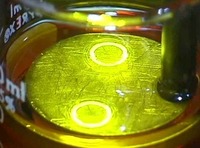
The University of Wisconsin has posted the procedure for a lithography experiment you might even attempt at home, providing you have sufficient chemicals, a front-projector and of course, rubber gloves:
 
In this lithography experiment light creates free radicals from phenylbis(2,4,6-trimethylbenzoyl)phosphine oxide which induce polymerization of 1,6-hexanediol diacrylate. Light is supplied by a computer projector which shines the pattern for one layer at a time. After each layer, the elevator is slightly lowered and the process is repeated. A dye (Sudan I) is included to prevent light from penentrating much below the surface of the solution.
 
Here's the materials list for the experiment:
 
  • 1,6-Hexanediol diacrylate (Aldrich 246816)
  • Sudan I (Aldrich 103624)
  • Phenylbis(2,4,6-trimethylbenzoyl)phosphine oxide (Aldrich 511447)
  • Computer with Powerpoint
  • Projector
  • Magnifying glass
  • Mirror
  • Platform elevator 
  
This is a very simple approach using more or less common items. We're wondering if this could be the basis for a low-cost hobbyist sintering kit? 

 

Reader Comments

There are no comments for this journal entry. To create a new comment, use the form below.

PostPost a New Comment

Enter your information below to add a new comment.

My response is on my own website »
Author Email (optional):
Author URL (optional):
Post:
 
Some HTML allowed: <a href="" title=""> <abbr title=""> <acronym title=""> <b> <blockquote cite=""> <code> <em> <i> <strike> <strong>