
 As reported yesterday, T. A. Grimm & Associates has published a very extensive benchmarking report on a selection of common commercial 3D printers. We’ve been looking forward to something like this because we all too often hear statements from vendors such as: “lowest cost of materials” and “five times better resolution” or “suitable for office use”. But these terms are vague at best until the actual devices are actually compared against each other in action. That’s precisely what this benchmark has done.
 So what does the report say? Lots, but here’s a few highlights that caught our notice:
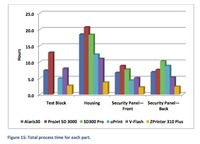
- When accounting for all aspects of time, the ZPrinter 310 is significantly faster to produce models than the other printers
- The SD300, while being inexpensive to acquire, is one of the slowest to produce models
- The ZPrinter 310 appears to be not only the fastest printer, but also the least expensive to produce a model, all-in costs considered
- The highest cost of materials, by far, is the SD300’s plastic sheets. Fortunately, the huge amount of waste cut-away is recycled
- The uPrint produces “by far” the strongest parts, with the Alaris 30 a distant second
- The surface finish varies considerably between printers, you’d best look at the test images
- The accuracy is quite variable and depends on the form of the object being printed by each printer
- The Alaris 30 is the most accurate 3D printer measured, and the V-Flash is the least accurate
- Biggest surprise for us: the ProJet SD3000 showed poorly in many of the tests, including quality, cost and time
Moral of the story/benchmark: No single performance factor tells the truth. Your printer might have the lowest material cost, but the cost per model might be the highest. A combination of all factors is the only way to truly estimate the operational cos t of any specific printer. The report concludes that the best and worst 3D printers cannot be ranked, as their performance depends entirely on the situation presented.
Wish: An additional report that measures hobbyist printers, such as RepRap, Fab@Home and the MakerBot. Their costs will be low, but their labor will be high.
Via T.A. Grimm

Itdoesn't take a genius to see evidence of HP's editing. Even when the HP or uPrint machine "loses", there's some sort of positive spin on it.
To me, the 2 most clear marks are :
– Their machine somehow beat or tied all other printers in the rankings
– talking about the printer's caustic support removal (sodium hydroxide): "beyond dripping of a little soapy water, there is nothing that would make a mess of an engineering office."
Yeah right… That's a lyme solution heated to 70-80°C (160-180°F)!!! You need chemical gloves, a face shield, and a respirator with this stuff. I've had to put my nose close to this stuff to pull parts out and I'm pretty sure I've lost my sinus and my lungs in the process.
Is this report neutral?
It has a note on the front and back page saying:
"This benchmark is distributed compliments of HP’s Graphic Solutions Business"
Does this mean that he was Contracted by HP to produce this report?
The HP machine does score favorably in the conclusion.