
Sponsors

Recommended
  • Rule 34
    Rule 34
    by Charles Stross

    Stross delves into a possible future where 3D printers become commonplace - and explores the problems that could result. 

  • Printing in Plastic: Build Your Own 3D Printer (Technology in Action)
    Printing in Plastic: Build Your Own 3D Printer (Technology in Action)
    by James Floyd Kelly, Patrick Hood-Daniel
  • 3Dconnexion SpaceNavigator SE (Standard Edition) 3D Navigation Device USB ( 3DX-700028 )
    3Dconnexion SpaceNavigator SE (Standard Edition) 3D Navigation Device USB ( 3DX-700028 )
    3D Connexion
  • The Homebrew Industrial Revolution: A Low-Overhead Manifesto
    The Homebrew Industrial Revolution: A Low-Overhead Manifesto
    by Kevin A. Carson
  • Mastering Blender
    Mastering Blender
    by Tony Mullen
  • Kindle Wireless Reading Device (6
    Kindle Wireless Reading Device (6" Display, Global Wireless, Latest Generation)
    Amazon.com
  • Blender 3D 2.49 Incredible Machines
    Blender 3D 2.49 Incredible Machines
    by Allan Brito
  • Makers
    Makers
    by Cory Doctorow
  • 3Dconnexion SpacePilot PRO - 3D motion controller - 31 button(s) - wired - USB
    3Dconnexion SpacePilot PRO - 3D motion controller - 31 button(s) - wired - USB
    3D Connexion
« Erik's Wedding Topper | Main | Fractal Tree Table »
Tuesday
Jul202010

Scanning Submarines

When you're capturing a 3D scan of an object, you are typically limited by the size of the scanner, if the scanner requires you to put the scanned object inside it. But there's also hand-held scanners that can overcome even that limitation. But how big an object can you scan? 
 
Creaform is going to find out soon as they've got the contract to provide scanning technology for the US Navy to scan submarines:
 
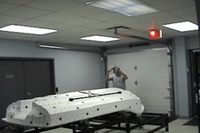
Portsmouth Naval Shipyard in Kittery, Maine, will be the first to receive an order of MAXscan scanners, the 2-in-1 photogrammetry laser scanner for large parts developed by Creaform. 
 
Specifically they'll be scanning the hulls of the subs, which by the way are coated in tiles made from a sound-reducing secret rubber compound. Inevitably this layer is scuffed through day-to-day operations and sufficiently damaged tiles must be replaced. 
 
The scanner will not only help detect which tiles are damaged, but also produce an accurate 3D model of the affected tile so that a replacement can be quickly produced. Clearly there's a secret 3D printer somewhere that spits out rubberized submarine tiles, but we have no idea where it might be. 
 

Reader Comments

There are no comments for this journal entry. To create a new comment, use the form below.

PostPost a New Comment

Enter your information below to add a new comment.

My response is on my own website »
Author Email (optional):
Author URL (optional):
Post:
 
Some HTML allowed: <a href="" title=""> <abbr title=""> <acronym title=""> <b> <blockquote cite=""> <code> <em> <i> <strike> <strong>
