
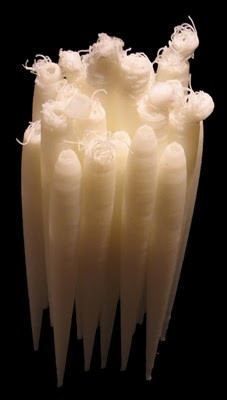
We ran across a very interesting operation: SMArchitecture, a “Kuwait and London based architectural & design R&D practice”. Their blog, written by Dr. Thomas Modeen describes their design experiments, which are often highly unusual and seem to have evolved from fabrication techniques. Some examples:
The ‘Comet’ vase, which consists of a bundle of hollow, extruded tear-drop shaped, funnels vertically staggered so that only three of the pointed base-tips touch the ground (forming thus a tripod stand).
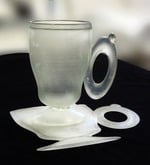
The Alice Cup: The core cup was designed in Rhino (software), made roughly the size of a 1.5 decilitre teacup, which was saved as a STL file, and consequently manipulated to befit a number of defined functions, such as an espresso cup (shrunk), café latte cup (stretched vertically) and a cream pitcher (stretched horizontally). It was also made into a saucer (horizontally flattened and stretched), as well as a pitcher (scaled up, stretched vertically and slightly flattened).

The Fragrant Time Clock, which: uses smell as the medium through which time can be told. The core premise is straightforward – take an incense-stick that burns at a regular speed, test and measure out the correlation between the length and speed at which it burns (i.e. how long a stretch of the stick is needed for, say, a ten minute burn?) and segment a select number of such incense fragrances into consecutive sequences and lengths according to preference.
These ideas are truly fascinating explorations of life-fabrication mashups that you can’t miss.
Via SMArchitecture

Great Stuff..!
Thanks for the feature and being featured…
Tom
Great Stuff..!
Thanks for the feature and being featured…
Tom