
Sponsors


Recommended
  • Rule 34
    Rule 34
    by Charles Stross

    Stross delves into a possible future where 3D printers become commonplace - and explores the problems that could result. 

  • Printing in Plastic: Build Your Own 3D Printer (Technology in Action)
    Printing in Plastic: Build Your Own 3D Printer (Technology in Action)
    by James Floyd Kelly, Patrick Hood-Daniel
  • 3Dconnexion SpaceNavigator SE (Standard Edition) 3D Navigation Device USB ( 3DX-700028 )
    3Dconnexion SpaceNavigator SE (Standard Edition) 3D Navigation Device USB ( 3DX-700028 )
    3D Connexion
  • The Homebrew Industrial Revolution: A Low-Overhead Manifesto
    The Homebrew Industrial Revolution: A Low-Overhead Manifesto
    by Kevin A. Carson
  • Mastering Blender
    Mastering Blender
    by Tony Mullen
  • Kindle Wireless Reading Device (6
    Kindle Wireless Reading Device (6" Display, Global Wireless, Latest Generation)
    Amazon.com
  • Blender 3D 2.49 Incredible Machines
    Blender 3D 2.49 Incredible Machines
    by Allan Brito
  • Makers
    Makers
    by Cory Doctorow
  • 3Dconnexion SpacePilot PRO - 3D motion controller - 31 button(s) - wired - USB
    3Dconnexion SpacePilot PRO - 3D motion controller - 31 button(s) - wired - USB
    3D Connexion
« Matthew du Plessis on 3D Printing | Main | The .MGX Collection »
Friday
Feb122010

MCOR Prints A Car

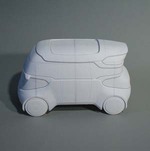
MCOR's Matrix 300, the 3D printer that prints in plain paper, was recently used by design students from London's Royal College of Art to produce a vehicle design, shown above. The MCOR Matrix is unique among 3D printers due to its use of paper as a print material, resulting in extremely inexpensive (and recyclable) media. The MCOR might visually appear to be dark grey with orange highlights, but inside it's quite green. 
 
Student Robert Hagenstrom printed a representation of a 3m-long four-seat vehicle with an elevated seating position. From TCTMagazine:
 
Robert’s concept managed to create a vehicle with a modular personal space inside, using only three metres of length. This was accomplished by putting two small direct drive electrical engines under the rear passenger seats, with batteries under the front seats, and having no explicit cargo space. Because all four seats are seldom in constant use, the vacant ones can be folded and used to store items on.
 
Here's the interesting part: the car is larger than the Matrix 300's build chamber. Thus, the designers had to print component parts and then fit them together. Apparently this was the first time the Royal College of Art attempted 3D print assembly on the Matrix 300, and it turned out well, according to Nick Grace, Manager at the Royal College of Art:
 
We were apprehensive about how well the component parts would fit together so were delighted when both the accuracy and the surface finish exceeded our expectations. We look forward to exploring this technology further; I think it has a great future. 
 
We're thrilled the environmentally-friendly MCOR device is making progress. 


Related Posts with Thumbnails 

Reader Comments

There are no comments for this journal entry. To create a new comment, use the form below.

PostPost a New Comment

Enter your information below to add a new comment.

My response is on my own website »
Author Email (optional):
Author URL (optional):
Post:
 
Some HTML allowed: <a href="" title=""> <abbr title=""> <acronym title=""> <b> <blockquote cite=""> <code> <em> <i> <strike> <strong>
