
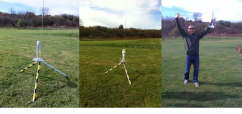
 You may be under the impression that 3D printers produce flimsy models, suitable for show – but not for action. This is generally true, but it’s changing as 3D printing ventures into metal or concrete printing. One project we’re watching is taking place at ZCorp, manufacturers of high-end commercial 3D printers. Mark Cook, ZCorp’s VP of R&D, recently reported that some of their engineers have begun work on printing custom designed rockets. From Cook:
 … a few that you would think had no business launching off a pad at a thrust of 10 – 30 Newton. This activity pushed limits of rocket design as well as 3DP capabilities. Simple cylindrical rockets were produced with average wall thicknesses of .025” in order to keep the weight down. More creative designs placed the rocket motor closer to the top instead of at the bottom. Another can be most easily described as a skeletal design having no skin or shell whatsoever.
We’re looking forward to seeing video or at least more pictures of their space exploration experiments.
