
Sponsors

Recommended
  • Rule 34
    Rule 34
    by Charles Stross

    Stross delves into a possible future where 3D printers become commonplace - and explores the problems that could result. 

  • Printing in Plastic: Build Your Own 3D Printer (Technology in Action)
    Printing in Plastic: Build Your Own 3D Printer (Technology in Action)
    by James Floyd Kelly, Patrick Hood-Daniel
  • 3Dconnexion SpaceNavigator SE (Standard Edition) 3D Navigation Device USB ( 3DX-700028 )
    3Dconnexion SpaceNavigator SE (Standard Edition) 3D Navigation Device USB ( 3DX-700028 )
    3D Connexion
  • The Homebrew Industrial Revolution: A Low-Overhead Manifesto
    The Homebrew Industrial Revolution: A Low-Overhead Manifesto
    by Kevin A. Carson
  • Mastering Blender
    Mastering Blender
    by Tony Mullen
  • Kindle Wireless Reading Device (6
    Kindle Wireless Reading Device (6" Display, Global Wireless, Latest Generation)
    Amazon.com
  • Blender 3D 2.49 Incredible Machines
    Blender 3D 2.49 Incredible Machines
    by Allan Brito
  • Makers
    Makers
    by Cory Doctorow
  • 3Dconnexion SpacePilot PRO - 3D motion controller - 31 button(s) - wired - USB
    3Dconnexion SpacePilot PRO - 3D motion controller - 31 button(s) - wired - USB
    3D Connexion
« The Homemade 3D Printer | Main | Opinions on HP's 3D Printer »
Thursday
Jan282010

Wallpaper Magazine Awards "R-O-B" Best Builder Award

Normally we who follow the 3D printing world expect to see a (probably) beige printer-like box containing a steamy build chamber from which excellent 3D objects are extracted. But the R-O-B is a very different kind of additive "printer".
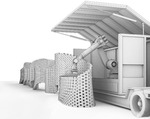
It's actually a full-scale industrial robot that's mounted inside a standard shipping container. The shipping container is dropped adjacent to the building site, and the side of the container swings open to reveal the R-O-B robotic arm. Then it begins to build.
 
Additive manufacturing in this case is a simple matter: the robotic arm merely picks up a standard block from its vast store, applies some cement and then carefully places (lays) the brick in the intended position. The process is repeated many times. Actually, an enormous number of times. Eventually the final structure emerges. 
 
We're tickled by this radical approach, which is essentially the same as traditional 3D printing, except it's a lot bigger. And slower. But the interesting angle is that you can build some incredibly interesting structures that might be quite difficult for carbon-based bricklayers to attempt. At least we would find it tricky. 
 
The video shows the R-O-B in place at New York City's Pike Street where it constructs an interesting wall over the course of some four weeks. The wall will be exhibited until July 2010. This is but one of several structures that it's built over the past year or so. The wall was devised by Swiss architects Gramazio & Kohler using technology developed by ETH Zurich.
 
We're wondering what this might lead to, as the question of 3D printing buildings seems to come up from time to time. However, R-O-B is likely a bit too slow to build larger structures. Its build chamber, erm, "build reach" would have to be extended as well. 
 
Via Wallpaper and dezeen (Hat tip to Andrew)

Reader Comments (1)

nice blog.

February 24, 2010 | Unregistered Commenterbest wallpaper collection

PostPost a New Comment

Enter your information below to add a new comment.

My response is on my own website »
Author Email (optional):
Author URL (optional):
Post:
 
Some HTML allowed: <a href="" title=""> <abbr title=""> <acronym title=""> <b> <blockquote cite=""> <code> <em> <i> <strike> <strong>
