
Sponsors


Recommended
  • Rule 34
    Rule 34
    by Charles Stross

    Stross delves into a possible future where 3D printers become commonplace - and explores the problems that could result. 

  • Printing in Plastic: Build Your Own 3D Printer (Technology in Action)
    Printing in Plastic: Build Your Own 3D Printer (Technology in Action)
    by James Floyd Kelly, Patrick Hood-Daniel
  • 3Dconnexion SpaceNavigator SE (Standard Edition) 3D Navigation Device USB ( 3DX-700028 )
    3Dconnexion SpaceNavigator SE (Standard Edition) 3D Navigation Device USB ( 3DX-700028 )
    3D Connexion
  • The Homebrew Industrial Revolution: A Low-Overhead Manifesto
    The Homebrew Industrial Revolution: A Low-Overhead Manifesto
    by Kevin A. Carson
  • Mastering Blender
    Mastering Blender
    by Tony Mullen
  • Kindle Wireless Reading Device (6
    Kindle Wireless Reading Device (6" Display, Global Wireless, Latest Generation)
    Amazon.com
  • Blender 3D 2.49 Incredible Machines
    Blender 3D 2.49 Incredible Machines
    by Allan Brito
  • Makers
    Makers
    by Cory Doctorow
  • 3Dconnexion SpacePilot PRO - 3D motion controller - 31 button(s) - wired - USB
    3Dconnexion SpacePilot PRO - 3D motion controller - 31 button(s) - wired - USB
    3D Connexion
« The Blueprints | Main | Bre Prettis at 26C3 »
Monday
Jan112010

3D Printing the Vasona Branch

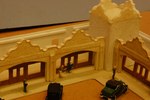
The "Vasona Branch" is a model railroad setup by Robert Vasona, who recently wrote on his experiences using 3D printing for a 1920's Drive-In Market section of the model railroad. 
 
Building unique structures is a constant interest among model railroaders, and it seems to us that 3D printing technology is more than an excellent fit for that need. Robert Vasona, as have other model railroaders, have been using the technology to build unusual pieces for their railroads. Recently he's been using a MakerBot.
 
Robert's encounter with 3D printing had several key learnings:
  • Duplicate parts ore easy. Normally model railroaders make parts by hand, and one can imagine the difficulty of producing identical parts. With a 3D printer it's easy. Just print two. 
  • Smooth surfaces are not easy. The MakerBot tends to leave "stripey" surfaces due to the nature of its extrusion. However, Robert fixed the surfaces: "I covered the face with spackle, gesso, or acrylic medium to try to smooth out the edges."
  • Part joins are easy. Building structures by hand usually requires joining several parts together, and the more parts involved, the more difficult it gets to align them all properly. But with a 3D printer you can simply print out the entire object without having to worry about part alignment. 

 

Reader Comments

There are no comments for this journal entry. To create a new comment, use the form below.

PostPost a New Comment

Enter your information below to add a new comment.

My response is on my own website »
Author Email (optional):
Author URL (optional):
Post:
 
Some HTML allowed: <a href="" title=""> <abbr title=""> <acronym title=""> <b> <blockquote cite=""> <code> <em> <i> <strike> <strong>