
Sponsors

Recommended
  • Rule 34
    Rule 34
    by Charles Stross

    Stross delves into a possible future where 3D printers become commonplace - and explores the problems that could result. 

  • Printing in Plastic: Build Your Own 3D Printer (Technology in Action)
    Printing in Plastic: Build Your Own 3D Printer (Technology in Action)
    by James Floyd Kelly, Patrick Hood-Daniel
  • 3Dconnexion SpaceNavigator SE (Standard Edition) 3D Navigation Device USB ( 3DX-700028 )
    3Dconnexion SpaceNavigator SE (Standard Edition) 3D Navigation Device USB ( 3DX-700028 )
    3D Connexion
  • The Homebrew Industrial Revolution: A Low-Overhead Manifesto
    The Homebrew Industrial Revolution: A Low-Overhead Manifesto
    by Kevin A. Carson
  • Mastering Blender
    Mastering Blender
    by Tony Mullen
  • Kindle Wireless Reading Device (6
    Kindle Wireless Reading Device (6" Display, Global Wireless, Latest Generation)
    Amazon.com
  • Blender 3D 2.49 Incredible Machines
    Blender 3D 2.49 Incredible Machines
    by Allan Brito
  • Makers
    Makers
    by Cory Doctorow
  • 3Dconnexion SpacePilot PRO - 3D motion controller - 31 button(s) - wired - USB
    3Dconnexion SpacePilot PRO - 3D motion controller - 31 button(s) - wired - USB
    3D Connexion
« FOC Left and Right | Main | First Surface »
Friday
Sep182009

Wanna Git SKDBing?

 
Bryan Bishop tells us of some very interesting work taking place at the Automated Design Lab at the University of Texas at Austin. As is often the case, when two different worlds collide, interesting things happen. This time it's software management and manufacturing.

In the highly complex world of software management there are monstrously complicated systems composed of in some cases hundreds of thousands of components, layered together in an intricate manner. All software pieces must interact faithfully using common conventions.

This is managed today by using numerous computing standards and advanced software management. That means "management software" keeps track of all these components to ensure the correct components fit together in the right sequence. Many systems today are so complex their management is literally beyond human comprehension.

Through the use of these advanced software management tools and techniques (think GIT or similar utilities), today's software has leapt into overdrive, with thousands of new applications appearing every day, created by both large teams and individuals. The management approach has allowed makers to take advantage of things that have already been built.

But that's software.

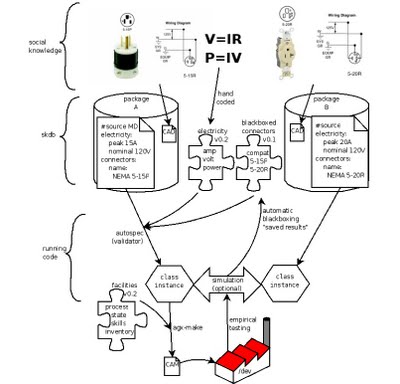
The Austin guys observed this huge software success and wondered if a similar approach could work for "real things". And that's precisely what SKDB is: a method of keeping track of hardware designs such that they can be easily found and assembled into useful objects.

It's clearly still in the research and development stage, but we feel that this approach could begin to make sense for many of the 3D model repositories currently emerging. While the file formats are known within these repositories, how do (or could) all these models fit together? Is there standard groupings of "parts" that can be re-used and re-mixed to create higher level designs? We think yes.

We know you want more info, and there's plenty of information at the SKDB wiki, and an overview presentation, too.

Via SKDB Wiki and SKDB presentation (PDF) (Hat tip to Bryan!)

Reader Comments

There are no comments for this journal entry. To create a new comment, use the form below.

PostPost a New Comment

Enter your information below to add a new comment.

My response is on my own website »
Author Email (optional):
Author URL (optional):
Post:
 
Some HTML allowed: <a href="" title=""> <abbr title=""> <acronym title=""> <b> <blockquote cite=""> <code> <em> <i> <strike> <strong>