
Sponsors


Recommended
  • Rule 34
    Rule 34
    by Charles Stross

    Stross delves into a possible future where 3D printers become commonplace - and explores the problems that could result. 

  • Printing in Plastic: Build Your Own 3D Printer (Technology in Action)
    Printing in Plastic: Build Your Own 3D Printer (Technology in Action)
    by James Floyd Kelly, Patrick Hood-Daniel
  • 3Dconnexion SpaceNavigator SE (Standard Edition) 3D Navigation Device USB ( 3DX-700028 )
    3Dconnexion SpaceNavigator SE (Standard Edition) 3D Navigation Device USB ( 3DX-700028 )
    3D Connexion
  • The Homebrew Industrial Revolution: A Low-Overhead Manifesto
    The Homebrew Industrial Revolution: A Low-Overhead Manifesto
    by Kevin A. Carson
  • Mastering Blender
    Mastering Blender
    by Tony Mullen
  • Kindle Wireless Reading Device (6
    Kindle Wireless Reading Device (6" Display, Global Wireless, Latest Generation)
    Amazon.com
  • Blender 3D 2.49 Incredible Machines
    Blender 3D 2.49 Incredible Machines
    by Allan Brito
  • Makers
    Makers
    by Cory Doctorow
  • 3Dconnexion SpacePilot PRO - 3D motion controller - 31 button(s) - wired - USB
    3Dconnexion SpacePilot PRO - 3D motion controller - 31 button(s) - wired - USB
    3D Connexion
« Anticipating 3D | Main | Build Your Own 3D Scanner? »
Thursday
Aug202009

MathMorph

 
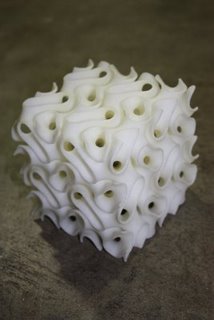
This intricate model was designed by Jonathon Anderson by adapting the MathMorph techniques. MathMorph? It's described this way:
First, a series of computer models were generated by computer algorithms, cellular automation, and mathematic equations using Maya and Houdini programs. These computer models were fabricated as physical prototypes by the Stratasys FDMTM (Fused Deposition Modeling) systems, CNC machine, and laser cut machines available at SCAD. The purpose of this part is bi-fold. It does not only inspire designers for the use of unconventional 3D forms in architectural design, which has traditionally been restrained by difficulties in design and visualization, but also tests the possibility of these unconventional 3D forms in being manufactured as physical prototypes.
This confirms again our opinion that there are no limits to our creative power. Shed the chains of reality!

Via Morphism Design and MathMorph

Reader Comments (4)

So, it's a http://www.bathsheba.com/" rel="nofollow">bathsheba clone, three years after the fact? How is this news?

August 20, 2009 | Unregistered Commenterbbot

It's not news; we just thought it was interesting.

August 20, 2009 | Unregistered CommenterGeneral Fabb

This is the beginning research into a project that will be looking at transforming traditional CMU architecture building blocks. Right now we, mathmorph, are beginning with cubes. As I move forward with the project i am looking at how these forms morph and populate a surface. It is there where the project moves past the traditional Bathsheba cube and moves into a conceptual idea. More will be posted as the project moves forward. here is an example of where the project may move into. http://morphismdesign.blogspot.com/2009/07/populating-surface.html

- Jonathon Anderson

August 26, 2009 | Unregistered Commentermorphism design

this model is also two separate units that were printed together. they are interlocked together and can move independently from one another.

August 26, 2009 | Unregistered Commentermorphism design

PostPost a New Comment

Enter your information below to add a new comment.

My response is on my own website »
Author Email (optional):
Author URL (optional):
Post:
 
Some HTML allowed: <a href="" title=""> <abbr title=""> <acronym title=""> <b> <blockquote cite=""> <code> <em> <i> <strike> <strong>