
Sponsors


Recommended
  • Rule 34
    Rule 34
    by Charles Stross

    Stross delves into a possible future where 3D printers become commonplace - and explores the problems that could result. 

  • Printing in Plastic: Build Your Own 3D Printer (Technology in Action)
    Printing in Plastic: Build Your Own 3D Printer (Technology in Action)
    by James Floyd Kelly, Patrick Hood-Daniel
  • 3Dconnexion SpaceNavigator SE (Standard Edition) 3D Navigation Device USB ( 3DX-700028 )
    3Dconnexion SpaceNavigator SE (Standard Edition) 3D Navigation Device USB ( 3DX-700028 )
    3D Connexion
  • The Homebrew Industrial Revolution: A Low-Overhead Manifesto
    The Homebrew Industrial Revolution: A Low-Overhead Manifesto
    by Kevin A. Carson
  • Mastering Blender
    Mastering Blender
    by Tony Mullen
  • Kindle Wireless Reading Device (6
    Kindle Wireless Reading Device (6" Display, Global Wireless, Latest Generation)
    Amazon.com
  • Blender 3D 2.49 Incredible Machines
    Blender 3D 2.49 Incredible Machines
    by Allan Brito
  • Makers
    Makers
    by Cory Doctorow
  • 3Dconnexion SpacePilot PRO - 3D motion controller - 31 button(s) - wired - USB
    3Dconnexion SpacePilot PRO - 3D motion controller - 31 button(s) - wired - USB
    3D Connexion
« Nanofactories | Main | Aureus! »
Thursday
Jun252009

MakerBot at Google TechTalk

 
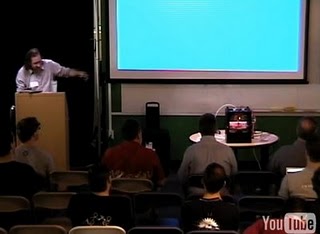
Enjoy a great 35 minute video of Adam Meyer, one of the three founders of MakerBot, speaking at TechTalk. Adam provides a good overview of the "juggernaut of 3D industry", Makerbot Industries. He speaks of the inspiration for MakerBot, beginning with the RepRap project and eventually leading to MakerBot's first product, the Cupcake printer.

They've taken the RepRap design and made it a whole lot simpler. They've made it smaller, more portable and changed some of the design. One of their optimizations is to reverse the motion paradigm: Instead of moving the heavy extrusion head during printing, they move the very light tray. Another innovation is to use wooden panels instead of the more fragile acrylic equivalents.

Their design is open source, so you can actually build your own makerbot, but they recommend buying the kit from them as it can be tricky to source all the parts efficiently. Being open source means you can tinker with the design. Really, they've made a platform from which we have no idea what might emerge. Adam's favorite unexpected item is a bathtub plug, which has given the world "cleaner nerds".

Adam also describes Thingiverse, a web site facilitating the sharing of 3D designs. We believe repositories of models is an essential part of an effective 3D environment, and Thingiverse could become much more important in future years.

There's a fascinating walk-thru of the entire sequence of printing, from design to motion of the build platform. A live demonstration of an ABS print takes place, showing some of the techniques they've used to overcome the stickiness of ABS. Ok, so we're nerds here too.

Via YouTube

Reader Comments (1)

So far, I have heard of 3 types of home 3d print materials: plastic extrusion, dental plaster (with water mixed with maltodextrin) and cornstarch. Are there any more mediums that are used, and has anyone made a list of their pros and cons?

June 27, 2009 | Unregistered Commenterp7

PostPost a New Comment

Enter your information below to add a new comment.

My response is on my own website »
Author Email (optional):
Author URL (optional):
Post:
 
Some HTML allowed: <a href="" title=""> <abbr title=""> <acronym title=""> <b> <blockquote cite=""> <code> <em> <i> <strike> <strong>
