
Sponsors


Recommended
  • Rule 34
    Rule 34
    by Charles Stross

    Stross delves into a possible future where 3D printers become commonplace - and explores the problems that could result. 

  • Printing in Plastic: Build Your Own 3D Printer (Technology in Action)
    Printing in Plastic: Build Your Own 3D Printer (Technology in Action)
    by James Floyd Kelly, Patrick Hood-Daniel
  • 3Dconnexion SpaceNavigator SE (Standard Edition) 3D Navigation Device USB ( 3DX-700028 )
    3Dconnexion SpaceNavigator SE (Standard Edition) 3D Navigation Device USB ( 3DX-700028 )
    3D Connexion
  • The Homebrew Industrial Revolution: A Low-Overhead Manifesto
    The Homebrew Industrial Revolution: A Low-Overhead Manifesto
    by Kevin A. Carson
  • Mastering Blender
    Mastering Blender
    by Tony Mullen
  • Kindle Wireless Reading Device (6
    Kindle Wireless Reading Device (6" Display, Global Wireless, Latest Generation)
    Amazon.com
  • Blender 3D 2.49 Incredible Machines
    Blender 3D 2.49 Incredible Machines
    by Allan Brito
  • Makers
    Makers
    by Cory Doctorow
  • 3Dconnexion SpacePilot PRO - 3D motion controller - 31 button(s) - wired - USB
    3Dconnexion SpacePilot PRO - 3D motion controller - 31 button(s) - wired - USB
    3D Connexion
« D_Shape Tech Prints Buildings | Main | The RapMan »
Thursday
May072009

Geological 3D Printing

 
It's not only geological, it's also transcontinental! What are we speaking of? It's an incredible proposal from architectural student Magnus Larsson, whose idea is almost beyond conception.

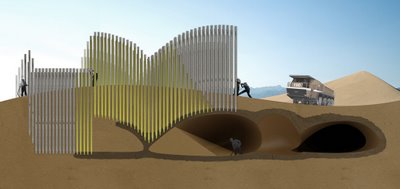
He proposes to use a form of biological 3D printing to create a habitable "green wall" across the entire width of the Sahara desert in order to reduce the effects of desertification.

The concept is to use flexible containers filled with common bacteria that are capable of solidifying the ubiquitous sand into rigid sandstone. By applying this technique on a continuous basis over many years, Larsson believes it is indeed possible to achieve this lofty goal.

According to Larsson:

... made straight from the dunescape by flushing a particular bacteria through the loose sand... which causes a biological reaction whereby the sand turns into sandstone; the initial reactions are finished within 24 hours, though it would take about a week to saturate the sand enough to make the structure habitable.

How can this actually work? Observe the artist's concept above and read Larsson's futuristic notions:
I researched different types of construction methods involving pile systems and realised that injection piles could probably be used to get the bacteria down into the sand – a procedure that would be analogous to using an oversized 3D printer, solidifying parts of the dune as needed. The piles would be pushed through the dune surface and a first layer of bacteria spread out, solidifying an initial surface within the dune. They would then be pulled up, creating almost any conceivable (structurally sound) surface along their way, with the loose sand acting as a jig before being excavated to create the necessary voids. If we allow ourselves to dream, we could even fantasise about ways in which the wind could do a lot of this work for us: solidifying parts of the surface to force the grains of sand to align in certain patterns, certain shapes, having the wind blow out our voids, creating a structure that would change and change again over the course of a decade, a century, a millenium.

Ambitious. Very ambitious. Let's get started!

Via BldgBlog and the Holcim Foundation

Reader Comments

There are no comments for this journal entry. To create a new comment, use the form below.

PostPost a New Comment

Enter your information below to add a new comment.

My response is on my own website »
Author Email (optional):
Author URL (optional):
Post:
 
Some HTML allowed: <a href="" title=""> <abbr title=""> <acronym title=""> <b> <blockquote cite=""> <code> <em> <i> <strike> <strong>